Happiness is an elusive concept, it brings about ideas of ecstasy, contentment, delight but also health and strength, pouvoir and puissance ... a state of mind and body that is precarious and contingent. How to give form and substance to an idea that is otherwise difficult to conceive? What is happiness for a chicken? What is it like to be a chicken today? Free-range certification offers a powerful interpretation of animals' happiness in the context of farming, and it does so by providing a particular translation of the `natural' in the domesticated environment of farming. But it also offers a specific definition of materiality, in the form of the body of the animal, presented as an expression of her/his quality of life in the juiciness and other organoleptic qualities of her/his flesh or eggs. In this paper, I present the results of an on-farm assessment of the welfare of free-range chickens in the UK, carried out by adopting the Welfare Quality protocol. This is a new evaluation of the on-farm welfare of animals that encompasses many aspects of animals' lives, including animals' negative and positive emotions. It suggests that animals' `happiness' can be measured and can become part of an overall score of welfare, but it also addresses the complexities of the interpretation of the emotional states of animals. I propose that this case contributes to the debate on `material politics' and the invention of animals' happiness can be seen as a political technique that affects human ^ non-human animal relations.
Miele M, 2011, "The taste of happiness: free-range chicken" Environment and Planning A 43(9) 2076 – 2090
It reminds me of the Posh Nosh episode. I can't help but feel that we've gotten our priorities all wrong.
Our workmate Elke celebrated her birthday last week. As a treat for all the omnivores at the office, she created an iconic 70s German party centrepiece - the 'mettigel', a hedehog made of raw minced pork.
The mettigel is something of an urban legend, and most of my workmates claimed never to have seen one "in the flesh". But here it was, in front of our eyes, all pink and glistening and terrifying.
If I had ever encountered one of these as a kid, I'm sure I would have had recurring nightmares. It's easy to imagine that thing creeping up the stairs and chasing children from their beds, leaving a slimy trail on the banister, shedding pretzel sticks in the thick shag carpet.
If you have the stomach for it, the TV skit below shows unemployed Herbert serving a mettigel as appetiser, main course and dessert to Uta the vegetarian and Klaus the architect. "If she has a weak stomach, she should have said so. Then I would have used the fresh eggs."
"...daft assumptions underlie the UN Food and Agriculture Organisation's famous claim that livestock are responsible for 18% of the world's greenhouse gas emissions, a higher proportion than transport. Fairlie shows that it made a number of basic mistakes. It attributes all deforestation that culminates in cattle ranching in the Amazon to cattle: in reality it is mostly driven by land speculation and logging. It muddles up one-off emissions from deforestation with ongoing pollution. It makes similar boobs in its nitrous oxide and methane accounts, confusing gross and net production. (Conversely, the organisation greatly underestimates fossil fuel consumption by intensive farming: its report seems to have been informed by a powerful bias against extensive livestock keeping.)
Overall, Fairlie estimates that farmed animals produce about 10% of the world's emissions: still too much, but a good deal less than transport. He also shows that many vegetable oils have a bigger footprint than animal fats, and reminds us that even vegan farming necessitates the large-scale killing or ecological exclusion of animals: in this case pests. On the other hand, he slaughters the claims made by some livestock farmers about the soil carbon they can lock away."
I'm always shocked that despite having 10,000 years practice at cutting up animals for food, we're still finding new systematic ways to do it. The NY Times runs through four of the new cuts of beef that the National Cattlemen’s Beef Association (USA) has deemed fit to market as new. The "boneless country-style beef chuck ribs" are intriguing for one reason: they're not of the ribs:
The "ribs" have never seen a bone. They are cut from the chuck eye roll to resemble ribs and are intended to be braised, like a short rib. They can be finished on the grill with barbecue sauce.
The American hunger for beef ribs is now so great that cows cannot contain enough of them.
I know this may be old hat to some of our Jewish big game hunting audience, but both giraffe meat and giraffe milk were declared kosher in 2008. From the aptly named Tim Butcher in the Telegraph:
"Indeed, the giraffe is kosher for eating," Rabbi Shlomo Mahfoud, who accompanied the researchers in their work, said.
"The giraffe has all the signs of a ritually pure animal, and the milk that forms curds strengthened that."
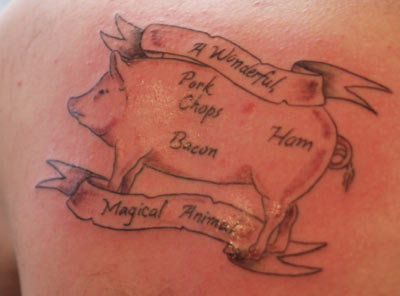
Flickr has a whole lot to answer for, in this case, the food tattoo pool. Thankfully, the hipster trend for cupcake tattoos is being replaced by the hipster trend for meat tattoos. They're not as classic as the BBQ tatt, but they're on their way there.
Despite Obama apparently expressing an appreciation for Michael Pollan's Open Letter to the president, Michelle Obama reaffirmed the family's" Joe The Plumber" sensibilities. Ahhhhh bacon, now elevated to the level of "every-man" political discourse
I'm not sure if there was wild horse culling in North Rhein Westphalia last week, but when I went to buy chicken for our chipotle salad, the meat section contained a truckload of horse in various stages of being chopped, processed or cured.
The whole horse meat thing is something I can't get down with. Hypocritical (considering I am OK with eating other equally noble & cute animals), yes. Do I care? No.
I tried horse sashimi in Tokyo and don't think I'll ever get over the memory of that strong, funky taste. Yuck.
In fact, one of my favourite Rheinland meat dishes, sauerbraten, was traditionally made with horse meat, though I've only had the beef version. It's marinated for a few days in vinegar and a sweetening agent, with spices like juniper and cloves, plus raisins, and then roasted. It turns out extremely tender and has that great sour/sweet/spicy edge to it. A very delicious christmas dish.
I guess I might one day give horse sauerbraten a go. But I've got to say the horsemeat bierschinken& jagdwurst below (luncheon meat, usually had on bread at breakfast time) looks like the devil's work.
Sirflank cooked at 58 C for 1 hour (you could go for a lower temp but this worked well for my diners, flank part on the bottom half). Finished with high heat in a wok.
Fear not my vegeterian friends. I just finished working on a ricotta dish using Activa TG-K (this binds dairy products) and have started on a tofu dish using Activa-TI for I do not want to leave out my vegan pals either.
Why did I not use Activa YG for my ricotta dish? (I new you would ask that)
Well I'll let AJINOMOTO CO.,INC explain. (somehow I became a German Chef but anyway)
Dear XXXX san, First, I’d like to confirm that already received samples from you. Thank you very much. Next, I just got request from customer. This customer is German Chef; he got information of ACTIVA YG from their friend in EU. He interested in ACTIVA YG for cheese product, and asks for the information of this product. I am not sure whether ACTIVA YG is produced in Japan or France, could you check please? In case that customer would like to test ACTIVA YG, how can I get ACTIVA YG sample? Thank you very much Best regards, Khun xxxx
...........
Khun xxxx ACTIVA YG is produced in France only. Regarding sampling of YG to your customer, I don't recomend now. As you know, we don't have approval of YG in Thai-FDA. I explain background of YG development for reference shortly. We have sold another product (ACTIVA MP) for dairy produts in EU about ten years ago. But we had a problem. ACTIVA MP does not work well when our customer use non, low or high-temperature pasteurization milk. According to our reseach, non or low-temperature pasteurization milk has inhibitory substance. After that, we developed new application that can control inhibitor. This new application is ACTIVA YG. ACTIVA YG uses reducing agent against inhibitor. If your customer use ultla high-temperature pasteurization milk, you can use ACTIVA TG-K as alternatives of YG. ACTIVA TG-K and MP are same function basically. I will send ACTIVA YG brochure. Would you please confirm attached file. You can check the basic function of YG. YG and TG-K are same about usage, dosage.
Bset regards, xxxx-san
...........
Dear xxxx san, Good morning. Thank you very much for your explanation, I understand. I agree with you that we do not want to pass YG sample to customer because of no Thai FDA approval. So I will discuss with customer about their application and condition to find out the possibility to apply TG-K. Thank you very much Best regards, Khun xxxx
So when you go to Shake Shack and stand in line for 30 mins to an hour and finally order your order hamburger, shroom burger, and frozen custard.... and before the staff hand you over the vibrating electronic device that "shakes" when your order is ready....ummmm.......you might want to try doing a little shake yourself a la Homer Simpson. If for instance, you wiggle yourself and your fat continues to wobble say five to ten seconds after you've stopped exerting yourself......well you might want to rethink your lunch choice, just saying...you know...for your health and vitality.
I'm not being mean, just honest, really.
If your wobbles are minor to non-existent, if say you are a Japanese tourist, go for it. Get the lot, guzzle down a shake burger, fries and custard. Why not try a shake shack shake too while your at it. I'm sure the shakes are great.
If however, your not quite hideously obese but could stand to loose a few squishy bits, as in my case, and if you promise to atone big time, then my advice is skip the fries, (they're just fried potatoes you know, you can live without them) order a 'shroom burger and share a small tub of frozen custard. Hock's shake burger is just a burger in my view, but the 'shroom burger was crispy mushroomy, cheesy and good. The frozen custard was dense and delicious. Follow with brisk walks all over NYC.
Day One, arrived ate a burger at JG Melon . Asleep but not stupid, waitress tried to over charge us by $10 bucks. Hamburger was everything ever dreamed about
Oysters and wine at Pj Clarks.
Walked through the park, musicians, rich kids with their nannies and resident weridos in the public loos. Cute babies in swings and lots of thorough bred dogs on leads
. "Ice scream you scream we all scream for ice cream"
Sleep. Awake now and off to Russ and Daughters for bagel and lox.......
A man walked into the Ritz Bar. The bartender said, "I heard that you lost a lot in the crash." The man replied, "I did. But I lost everything I wanted in the boom." This exchange, from F. Scott Fitzgerald's "Babylon Revisited," a story set early in the Depression, suggests how a time of economic crisis can provoke a reckoning with what matters most.
That is not glibly to say, in the manner of a moralizing preacher, that concern with money is trivial, or that worry tied to last week's financial jolts is only greed. Job loss, pension insecurity, threat of foreclosure, the squeeze of debt, rising cost of living - if these problems are not properly a source of anxiety, nothing is.
But what is money? There is a clue in the reference in Fitzgerald's title. Babylon, the ancient Mesopotamian city on the Euphrates River, lives in memory as a place of license and sensuality. If captive in Babylon, it is important to maintain a spirit of detachment from its excesses. That's the Biblical reference.
But in the mists of time, predating the Bible, civilization was itself born in the alluvial plain between the Tigris and the Euphrates. That occurred when nomads - hunters, gatherers, herders - settled in cities that were built around agriculture. One of the main innovations of the settled life based on farming was the capacity to accumulate more than was needed to live. This surplus was both a boon - it enhanced survival - and a curse - it led to the organized thievery of social class. The management of surplus became a valued skill, the idea of wealth was born, and, even allowing for inequity, the human species made its great evolutionary leap.
But money predates agriculture. Anthropologists speculate that the first form of currency - a symbol whose value is imputed rather than inherent - were the pieces of flesh that hunters tore from a vanquished beast. It was not only that successful hunters could then eat to live, but that they could take morsels of meat back to their social circles, however defined. The meat had value in itself, but soon enough it took on transcendent worth.
Indeed, the tearing of flesh from the bones of the killed animal became ritualized, a possible origin of religious sacrifice. A kind of divinity was attributed to the victim, which, after all, was now the source of sustenance, and vestiges of the victim's body were now considered to be holy.
The torn meat became something to exchange, a way to accommodate new divisions of labor, compensating those whose contributions to community survival was less direct than joining in the hunt. A sacred aura hung over the whole enterprise, which may have made it work. The bull as a symbol of the stock market, a contemporary sacred cow, is thought to be rooted in this ancient phenomenon. (The historian Dennis King Keenan suggests that the Latin word pecunia comes from pecus, meaning cattle. The English word "money" comes from the Roman goddess Juno Moneta, in whose temple bulls were sacrificed.) Money's subliminal connection to divinity is enshrined even in the way communion wafers of the Christian liturgy are shaped like coins. A sacrament exists to point beyond itself to something sacred. It is not too much to say that the first sacrament was money.
Meat as a form of currency makes the meaning of money clear. Nutrition is what humans need to live. Stored nutrition, managed by a system of credit, is what humans need to live without obsessing about the next meal. All that we associate with civilization followed from that freedom - from writing to art to concern with consciousness itself. Civilization erected walls to protect against the contingency of existence on a dangerous planet, and the chief emblem of that protection is money.
Because direct awareness of normal human vulnerability - the beasts are still out there - is so frighteningly immobilizing, it became normal to think that what protects us is absolutely trustworthy. That is why primitive humans began to explicitly regard their money as divine, and it is why, equally, if less explicitly, we do, too.
But, in fact, the money is not what protects us. Nor do the gods. Human inventiveness is our protection, and that remains firmly on display.
Aaaahhhhhh, somehow anthropological musings on the current global finance calamity makes it all seem so much more manageable. Anthropologists love to stress that so many of the challenges faced by humanity are in fact human constructed, yet we fetishize them as if they were beyond our control. If only we would wake up and see that the only limits are the collective ones we place upon ourselves they seem to taunt. And while this is to some degree true, understanding that meat is the pre-modern money and it is all linked to social status within tribes and groups, and that is what gives it it's power, does little to allay my fears that our savings may not be safe and that the US dollar is likely to collapse
American obesity has doubled since 1980. The Times published a table from the Agriculture department comparing food consumption in 1970 and now-ish. The foods with the biggest increase in consumption are spinach, garlic, cream cheese and corn sweeteners. Spinach, garlic and corn sweeteners, one can think of obvious reasons why they might've increased.
But cream cheese? Maybe the 350% increase in production can be accounted for as a new baking ingredient (cakes etc). Maybe it used to be more of an 'East coast thing' whereas now it's frequently used in place of butter. Any Americans who can remember the early '70s care to comment?
Maybe there's a new trend in sweet spinach garlic chicken cream cheese pies.
"In 1970, the average American ate about 16.4 pounds of food a week, or 2.3 pounds daily. By 2006, the average intake grew by an additional 1.8 pounds a week. (...)An extra half pound of fat weekly - mostly from oils and shortening. That doesn't count the fat in the extra quarter pound of meat Americans now eat every seven days. Those fats were somewhat offset by a steep drop in dairy consumption, the only major food group to have a decline, primarily in milk drinking. (But we do love our cheese. More and more of it.)"
If you have that bourgeois, obsessive-compulsive habit of photographing food, no doubt you've also accidentally collected quite a few shots of people caught in the act of stuffing their faces. Hence: the Hand to Mouth series. Gut Feelings members, I heartily invite you to add your own.
And in the interests of bringing myself down a peg or two, I present:
#1: Chewing ribs in Porirua, Wellington, New Zealand.
At least it is if you're counting in Roman numerals.
I know that this may be adding a dash of kero to the flamewar, but Maytel's redacted post reminded me of a point that Michael Pollan makes incredibly badly. From the everyone's favorite justification for carnivorousness, The Omnivore's Dilemma (p.231):
Domestication is an evolutionary, rather than a political, development. It is certainly not a regime humans somehow imposed on animals some ten thousand years ago. Rather, domestication took place when a handful of especially opportunistic species discovered, through Darwinian trial and error, that they were more likely to survive and prosper in an alliance with humans than on their own.
Pollan goes on to explain that domesticated animals lead much cushier lifestyles than their counterparts whom languish in what is left of Nature. This argument seems like an ecologist's version of the bumper sticker slogan that if God hadn't wanted us to eat animals, He wouldn't have made them from meat. Just replace the deity with evolution. A few pages later, he argues that unlike domesticated animals (who made themselves through their own opportunism) humans made bisons. He quotes Tim Flannery:
"the bison is a human artifact, it was shaped by Indians"
I'm still confused as to why Pollan attributes agency to domestic animals (it was their own fault that they exist and are full of meat) but not to wild ones (who man made full of meat, through predation).