Showing posts with label bärlauch. Show all posts

炒める: Japanese-style sauté

Photo Sharing and Video Hosting at Photobucket

When we go out to the Kushitei izakaya in Duesseldorf, I always get a nantoka-itame (something-or-other stirfry) from the special menu. They usually have a really yummy one made from veges and pork with chopped spicy 'zasai' pickles, which are the slightly milder but still hot Japanese version of Sichuanese zha cai, crunchy pickled mustard stem.

Itameru is the Japanese verb, which the Japanese wikipedia page likens to sautéing. However, the origins of '炒め物' (stir-fried dishes) in Japan, are obviously Chinese, and according to oh-so reliable wikipedia on their Japanese cuisine page, these "mock-Chinese stirfries" (?) have been a staple in Japanese homes and canteens since the '50s.

Somehow when I think of the western version of the Chinese stirfry, I think of a very hot, very energetic frying method with plenty of oil. Clearly in China there are many different ways to fry and braise food in a pan, and the Japanese itameru method derives from the slower end of that scale, which might be why the web page compares it to sautéing.

However apparently elements of a good French sauté are that the food is not crowded into the pan, without absorbing the fat or stewing in its own juices, and at no cost must moisture steam or stew the food.
On the other hand making itamemono usually does involve a big mess of food and flavours, and although the end result is usually not mushy, it is quite common to pour a little stock or sweetened soy sauce in at the end to braise/coat the food, and to jumble/marinate the flavours together a little more.

When I think of a nice itameta dish I think of a casual, homey dish, at least 2 ingredients cut up in in small pieces, still a bit crunchy and not too oily, flavoursome with an ingredient like garlic chives or small pieces of pork, or sesame seeds, or sugar and soy. And of course, perfect with rice.

The following dish is quite mild so I recommend to serve it with some really good kimchi cabbage and crunchy kimchi cucumbers. To really get your pan-asian (con)fusion going on.

肉にら炒め
Nikunira-Itame (meat & chinese chives stirfry)

(adapted from the cookbook '15分ラクうまおかず by Shufunotomo (housewife's friend) press)

150 g thinly sliced pork (as you would use for shabushabu or such)
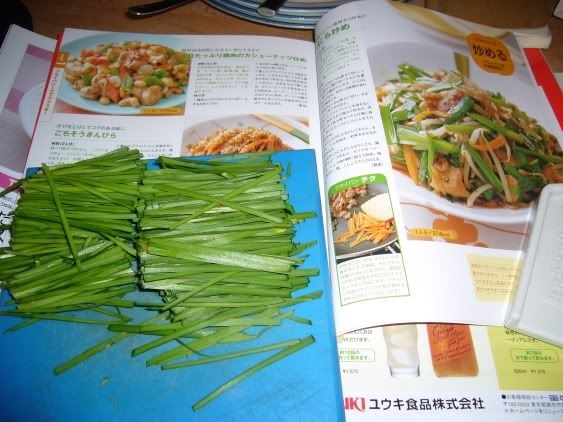
One packet of Nira (chinese garlic chives) (about 30g?), cut into 4 cm lengths (substitute with bärlauch if unavailable)
Half a smallish bag of moyashi/bean sprouts
25 g carrot, peeled and cut into 4 cm long, 3 mm thin juliennes

A [salt, pepper, 2 tsp flour, 1 tsp olive oil]
2 tbsp sesame oil
1/3 tsp organic vege stock powder or kombu kelp stock powder
1 tsp oyster sauce
2 tsp soy sauce

Roughly chop the pork into 4-5 cm lengths and mix it with A using your hands.
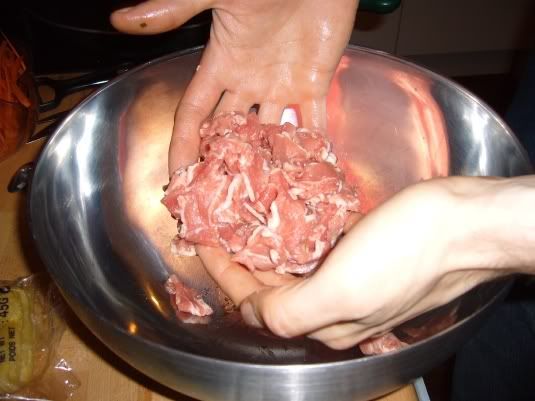
Photo Sharing and Video Hosting at Photobucket

Heat the frying pan, warm the sesame oil and stir fry the pork at a high heat. When it begins to colour, add the carrots. You might like to move the pork to one side of the pan and move that side of the pan off the heat, so that the carrots can absorb the juices and cook, but the pork doesn't get overcooked. When the carrots begin to soften add the beansprouts and nira/chinese garlic chives and stir fry it all about.

When it all seems pretty much cooked to your preference, add the soup stock, oyster sauce and soy, turn off the heat and mix it all about until well coated, then add salt & pepper to taste. Serve with hot rice and plenty of funky kimchi.
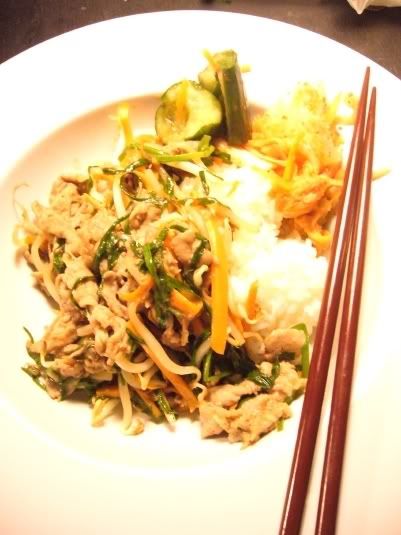
Photo Sharing and Video Hosting at Photobucket

Ponzu de replay: rice with nira & egg soup.

The main theme for the August '07 issue of オレンジページ (Orange Page) magazine is 'summer drinking snacks fiesta'.

The recipe which we especially loved this month though, was on a page titled さらさらご飯 (Sarasara Gohan). Gohan means rice. Sarasara is an onomatope which can be used to describe the sound of a flowing brook, the feeling of smooth dry skin or the whisking of tea, amongst other things.

In this case it's being used to describe the special 'tsuyu' used in this summer recipe, a refreshing soup base made only from citrus & rice vinegar & soy a.k.a ponzu-shoyu (most common brand is 'Ajipon') and water.

Ajipon's web site claims Ajipon was developed in 1964, when the now ubiquitous ponzu was not so common. The Mitsukan president had some mizutaki in a restaurant and decided to mass-produce this fabulous dipping sauce. Three years of experimentation with different types of citrus and degrees of saltiness led to 'Ajipon', which includes mirin, katsuo-bushi, konbu (kelp), rice vingar, lemon, mandarin and valencia orange in its formula. Supposedly. Though the ingredients list on the label also includes corn syrup and glaringly omits the sweet mirin cooking sake, katsuo-bushi fish flakes and konbu.

MySpace Codes


Ponzu is commonly used as a refreshing dipping sauce (especially for nabe hotpot) or as a salad dressing ingredient...this is the first time I've seen it as a soup base. Orange Page also recommends, on really hot days, to pour the same water-ponzu mixture over rice, but to chill the soup first. Now that's sarasara.

Ponzu tsuyu soup base:
Combine 1/4 cup of Ajipon or other flavoured ponzu-shoyu with 1 cup water.

Recipe: rice with chicken-Nira-egg-soup
Adapted from Orange Page magazine.
Serves 2.

1 chicken breast (50 g) - or 1/4 sachet konbu kelp stock powder
Nira (garlic chives, 韭菜 or ku chai in chinese, could be substituted with bärlauch) 1/3 bunch (30 g)
2 eggs, lightly beaten
2 medium-sized bowls of warm rice (about 300 g, I think we used a little more though)
Ponzu tsuyu soup base

- If you are using chicken, cut it into 5 mm bite sized pieces; trim the nira and cut it into 2 cm lengths.
- In a small pan, heat the chicken or konbu powder and the ponzu tsuyu over medium heat. Skim off any foam and add the nira. When the ingredients seem cooked, add the beaten egg while stirring. When the egg-soup mixture has thickened somewhat, turn off the heat and pour an equal amount over each bowl of rice.

(We made this without the chicken, and instead added a 1/4 sachet of konbu stock powder to the broth. It was totally delicious. Savoury, a little piquant from the vinegar but not sour or sharp at all; warm, mellow and tasty from the Nira/garlic chives, which are available from all asian grocery stores: just look for the long-ish grassy chives-like ready cut bunches).

Photo Sharing and Video Hosting at Photobucket

Note: the ideal time to eat this may be in summer, but let's face it, it's not much of a summer in Cologne at the moment. The deep savouriness of the dish does however lend itself to a warming meal when the skies look so grey and ambivalent - and of course, any soupy-kayu-type dish with rice has its comfort value.

Blogger Templates by Blog Forum