Showing posts with label American Food. Show all posts

Quote of the Day

The 1969-70 "Menu" B-52 bombings of Cambodia's border areas, which American commanders labelled Breakfast, Lunch, Supper, Dinner, Desert and Snack, aimed to destroy the mobile headquarters of the South Vietnamese "Vietcong" and the North Vietnamese Army (VC/NVA) in the Cambodian jungle. However, these and later bombardments forced the Vietnamese communists further west and deeper into Cambodia, and ultimately radicalized Cambodian local people against Lon Nol's regime.


Ben Kiernan and Taylor Owen on the similarities between the current war with Afghanistan and the past bombing of Cambodia

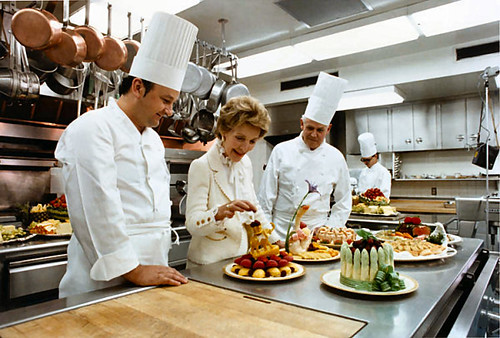
White House Kitchen Snaps

kitchen-reagan-1982

Every president and first lady is different. Some, like Mamie Eisenhower, are intimately involved in choosing the menu for dinners while others, like Pat Nixon, want the chef to surprise them. After the first large Nixon dinner, Chef Henry Haller went to Chief Usher JB West. "The president came into the kitchen tonight and told me it was delicious. Can you imagine? The president himself. That never happened before."


Link

Sweet Potato Pie

sweetPotatoPie

Our friends Ina & Harry are quite partial to pumpkin and sweet root veg, especially in the form of desserts or jams. Harry suggested we have a sweet potato pie-making party with prosecco yesterday.

It seems like just the other day that we christened the start of spring with rhubarb-quark cheesecake in Ina & Harry's garden, shortly after they moved into that house. But in the mean time a new resident has arrived: Johanna (see gratuitously cute baby pic below).

I can assure you, despite the teeming wildlife (birds pooping on the garden table and rustling in the bushes, toads getting frisky in the pond) we were smiling like Johanna on the inside after collectively baking that pie, cooling it on the window sill, and after many glasses of prosecco and strong cups of coffee, eating the pie in the fresh air.

If you like, you can de-veganize the recipe by adding an egg to the filling (make sure to reduce the amount of tofu a little -but do not eliminate completely, as the tofu adds good texture without too much richness). Yesterday I added an egg to the crust, which made it a little chewier and less crispy-dense than usual.

johanna

Sweet Potato Pie (adapted from a recipe in the Fresh At Home cookbook by Ruth Tal Brown)

Crust:
3 cups flour (I use a mix of wholegrain and light spelt flour)
1/4 cup raw sugar
1/4 tsp baking soda
1 tsp cinnamon
3/4 tsp salt
1/3 cup warm water
1/3 cup olive oil
1/3 cup margarine

1. Grease & flour a pie plate or crockery dish for tarts/quiche
2. Combine dry ingredients.
3. Add marge and oil to dry ingredients and rub it in with your fingers
4. Add water and mix thoroughly. Add more oil or water if the dough won't hold together.
5. Press the dough straight into the dish (I find that this is faster and just as effective as rolling it out first)
6. Pierce all over with a fork
7. Bake for 15 min at 175 degrees then remove to cool. Leave the oven on to keep it warm while you add the filling.

Filling:
3 medium-large sweet potatoes, peeled and diced
3/4 cup silken tofu
2 tbsp grated ginger with juices
1 tsp salt
1-1/2 tsp cinnamon
3/4 tsp fresh grated nutmeg
1 cup maple syrup or brown sugar (this time we used palm sugar)
1/3 cup of vegetable oil (sunflower, rapeseed, olive)

1. Simmer sweet potato pieces til tender
2. Blend or mash all ingredients thoroughly (you can reserve a few pieces of sweet potato to mash for the baby)
3. Spread the filling in the slightly cooled crust and bake at 175 degrees for 30 min or until top is slightly browned. Remove and cool on a windowsill before serving.

Virgins of the American Food


Here's the Burger King's advertisement site.

There are already plenty of criticisms and people blogging about this, such as:

Minnesota Hmong protesting against Burger King's Whopper Virgins campaign, on Twin Cities Daily Planet

Burger King Offends Global Culture on the Telegraph by Emily Haile

Burger King is Despicable: A Rant by Pico and the Man

Like the above two bloggers I guess the critics would find refuge in the Inuit's man's remarks that he prefers seal meat over hamburgers... but since the BK shows it as a part of their documentary-ish ad, I wonder if this is carefully crafted by the BK ad crew.

While I haven't been to either Baan Mon Kghor or Baan Khun Chang Kian myself, I also wonder if these villages are really that remote, in a similar vein with what Seng Vang is commenting:
This is obviously a false, as the specific people in the ads (who are our relatives) HAVE seen burgers before, lots of it. Almost every Hmong Thai villages in Thailand have a TV. Thailand has how many BK franchises? How many commercials in Thai have these franchises run in the past several decades? Even the most remote Hmong villages in Thailand, like the ones in your ad, drive Toyota Tundras, talk to their relatives in St. Paul on their cell phones, and watch CNN and BBC on their satellite TVs. Never seen a burger? Pure fiction. Hmong villagers in Thailand aren’t as backward or primitive as you want Americans or the world to think.
From what I have seen in the mountains of Thailand, some Hmong villages are indeed remote with no electricity, but some Hmong villages are electrified, in that case villagers do own satellite dishes.

I wonder why the BK ad crew chose the Hmong people of all "remote" and "tribal" people they could choose from, even though there are significant number of Hmong people who have immigrated to the U.S. after the Vietnam War, who would voice their opinions. If they wanted to pick up some of the most "remote" and "tribal" people from Thailand, they could have gone for the Mlabri people, for instance.

My guess is that the BK ad crew picked the Hmong villages because they are actually some of the most accessible of all the tribal villages. In the documentary-ish video, the Hmong people there are actually speaking Thai, and I won't be surprised if they have come down to the city of Chiang Mai and came across BK and McDonald's outlets in the night bazaar area where they'd sell their beautifully embroidered goods and silver jewelry to tourists.

Food Quote: Stomach vs. Quinoa on the Biggest Loser

In the four months of taping, contestants are given a calorie budget, recipes and a list of forbidden foods: no white flour, white sugar, butter, or anything that contains them. From there, they have to learn to feed themselves.

“It wasn’t pretty,” said Mr. Brantley’s wife, Heba Salama, who began the show as the heaviest woman ever to compete, at 294 pounds. “The kitchen was full of weird ingredients like quinoa and kale. It was the blind leading the blind.”


Source: NYT

Kitchen Gardens

I have been writing my second to last chapter lately on vegetables. Within agricultural development ciricles it is a well known fact that the emergence of fresh fruit and vegetable commodity chains are indisputably linked with a rise in development and propserity specifically of the middle class urban dwellers. Growth and propserity in Asia in recent years has seen the proliferation of fresh fruit and vegetable production and marketing, with this region now accounting for over fifty per cent of worldwide production. Most of thise produce is consumed locally if not regionally.

In Cambodia, kitchen gardens are a common sight around the raised household lands or river banks where the perils of flooding are diminished. These polycultures are known in Khmer as chamcar. More recently specilaised growers have emerged in nearby provinces supplying the growing consumer market. But still, for the most part, kitchen gardens in Cambodia exist to service the day to day non-market needs of domestic kitchens

On the other side of the world vegetable gardening has seen a resurgence in the developed world. Garden centres have reported increased sales during the financial crisis as people turn to cheaper hobbies that also provide sustenance.

Growing your own occupies a special place in a lot of people's psyches. My own little vegetable patch in Canberra gives me unique sense of satisfaction, and I find myself often memorised by my vege.

It is however, far more of a hobby than it could ever be called "livelihood strategy". For that I would need a much larger plot, seedling production centre and possibly be growing some grain as well.

But for now I potter and I gaze. I relish in the fact that my strawberries are so happy and I am puzzled by my tomatos sad performance.

It seems that in the west the history of kitchen gardens has always been an earthly pursuit of the wealthy or middle classes, first emerging as part of the economies of large feudal estates, and toiled by estate workers to cultivate and provide the freshest and most seasonal and sometimes exotic varieties to the tables of their masters. I read this in the History of Food book, which also noted that the popularity of kitchen gardens grew tremendously in France with the rise of the bourgeoisie.

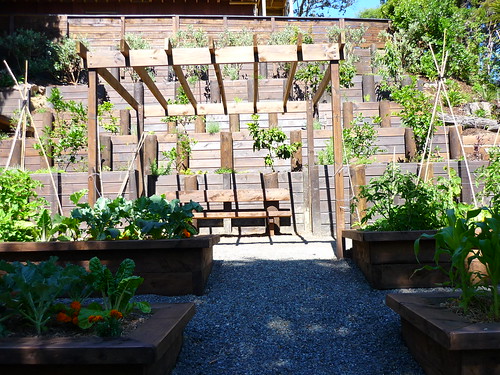
My sister's has a kitchen garden of this order,of course, in true big sister style the eldest has the most enviable of gardens, carved out the clay soils of the Waitakere ranges, the garden is unlikely to ever "pay" for itself in vegetable yield terms, least the entire world meltdowns and New Zealand remains cut off from international trade and the film industry in which she works (an event it seems that my sister is apparently prepared for giving her predilection to hoard cans of food and bottles of wine)

P1000170

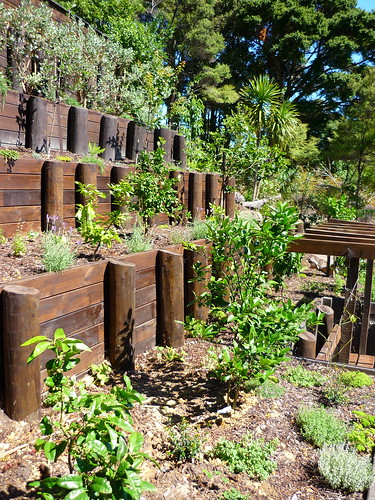
The garden cascades down the hill from fruit tree terraces lined with feijoas and heirloom variety pears, limes, grapefruit, lemons, peaches etc etc which is interspearsed with edible herbs and other vegetables such as squashes, cabbages and cucumbers. The pergola with sitting bench is framed by two grape varieties to the side and passionfruit vines to the front

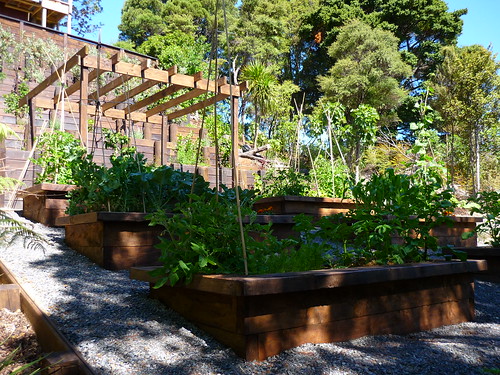
P1000176

The raised beds are planted at the moment with summer vegetables of all variety, corn, tomatoes, potatos, raddishes, peas, beans.....These are interspeared with marigolds and other herbs

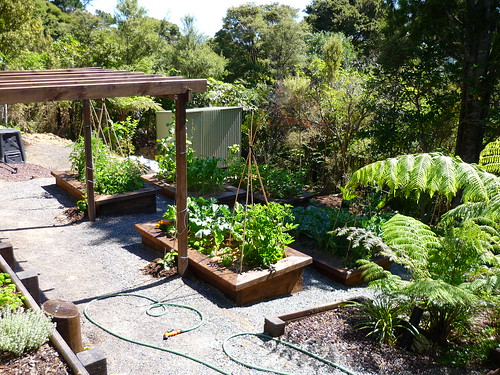
P1000168

Plans are afoot to start bee hives behind the garden shed too

The garden gets a lot of sun but is sheltered from wind by native New Zealand bush. Around the outer borders before the bush begins are strawberries, sage, tamarillos trees.

Finally there is a platform suspended up the terraces where one may lounge in partial shade , read a book and survey with satisfaction the view of fruit and vegetables growing.

P1000167

This garden truely out does my modest patch of dirt, it verges on an estate garden in my books and fulfils in all my family's pastoral fantasies that our middle class status permits us to have....When I'm there I wander around the garden, picking off sprigs of herbs for making salsa verde. My other sisters like to sit and wander too. But of course my sister has a gardener that comes a couple of times a week to look after the garden, she is after all very busy making money "off-farm"

Which brings me to all the kerfuffle about the White House garden and the Alice Watery and Michael Pollan demands for the White House to dig up the lawn and plant an organic vegetable garden. This is in some way supposed to be "symbolic" of the presidents commitment to good fresh local food, and a commitment to transforming the american agricultural system from the pit of disaster that it currently is..... But should the Obamas capitulate to these requests by middle class food champions? Should the White House be aiming to fulfil the pastoral daydreams of Alice Waters by planting an organic garden. They'll be no shortage of serfs this year to tend these gardens no doubt.....or should Obama not worry so much about the front lawn and concern himself with the very real challenges of transforming the agricultural system and rural communities, rethinking farm policies and introducing a new farm bill?

Another Food Ranter


More on The American Stomach

Food Quote of the Day

We’re bacon people


Michelle Obama on ABC and "The View"

Despite Obama apparently expressing an appreciation for Michael Pollan's Open Letter to the president, Michelle Obama reaffirmed the family's" Joe The Plumber" sensibilities. Ahhhhh bacon, now elevated to the level of "every-man" political discourse

Have Yourself a Very Vege Christmas

vegechristmas

Last night we decided to have a Christmas dinner with our friends Demi & Carmen before they went to visit their families in the countryside.

I found a bunch of recipes on websites (something I rarely do - I prefer the analog world of cookbooks), and Carmen heated up some apple wine from a quirky old commune called Matsch & Brei ('smash & mash'), where they grow the apple trees in the traditional German permaculture style. The reason she heated it and added cinnamon and cloves, was due to her experience serving it to a family in Chicago, whose reaction was that it tasted like vomit. It is sort of watery, sour and dry, but I found that served this way I enjoyed it.

While meat, mashed potatoes, mint sauce and gravy might be the backbone of a kiwi christmas, having lived in Germany for a few years, this kind of solid repast isn't especially celebratory to me anymore. Plus I'm not necessarily a huge fan of traditional roasted meats: give me simmered, sautéed, smoked, braised or barbecued any day. It's great to have such hearty pub-food at the Brauhaus from time to time, but to feel like I'm making real seasonal celebrational dishes, I want something that doesn't feel like everyday fare: something with buttery spiciness, creaminess, apples and oranges. Preferably arranged in huge piles.

With the recipes gleaned from sites like Epicurious and the Fork in the Road blog, we did an all-vege menu: with two of us cooking the whole thing took probably an hour and a half.

poblanogratin

1) Potato gratin with strips of poblano chile. This was realllly good. For those of us not living in places where fresh poblanos are readily accessible, you can quite easily buy little tins of rajas (poblano strips) from Mexican import companies. We used a 250 g tin.

2)Broccoli with wine, citrus zest & garlic
. This was the only dish that didn't make me break out in 'ooh's and 'aaah's, but the slight bitterness and the citrus zest added a lot to the overall Christmas vibes of the table. Marks for effort.

3) Savoy cabbage coleslaw with creamy mustard-apple vinaigrette & walnuts. Refreshing and crunchy, I really enjoyed this, though Germans who like their kraut-salat a bit softer could prepare it the day before serving.

gingerbeans

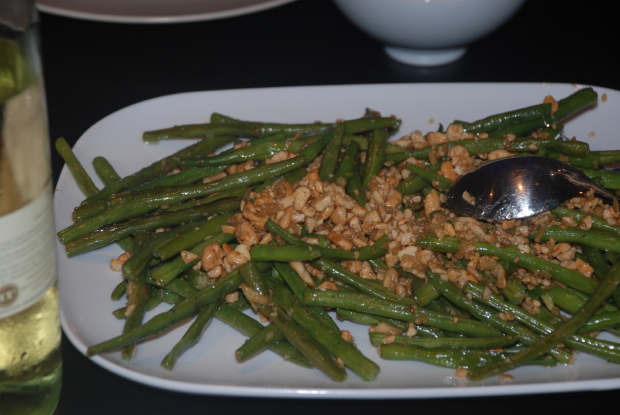
4) Buttery green beans with ginger & roasted, salted crushed cashews. Simply: DOPE.

5) Little baby jesus cake. Obviously, the main reason I wanted to make this was because of the name. It's a lighter version of sticky date pudding: there's three tablespoons of butter in the cake itself, with two more (and a half cup of cream) in the sauce. I baked it in a flan/quiche dish so it took less time to cook than the recipe says, about 30 minutes: count on the full recipe serving eight people, otherwise you will end up eating it for breakfast with a hint of regret, as I did. Easy to whip it up while your guests are festively huddling around the computer after the main course, looking at sneakers online.

sneakerchristmas

Serve dessert warm, straight out of the oven, with butter & brown sugar sauce, persimmon and greek yoghurt. Complimented by Pegovino grenache/syrah and a sentimental 80s flick like When Harry Met Sally.
I found that Meg Ryan goes over quite well when you're on your third serving of Baby Jesus.

babyjesus date cake

100 things in the shape of a miniature turkey


Over the last three Thanksgivings, Danielle Spencer has been making random turkey-shaped foods, which has subsequently turned into a competition of sorts. I'm partial to the above egg turkey.

More Food Shortages

PH2008112902188

When Barack Obama reaches the White House this January, he may find a whole other crisis on his hands, squirrel famine

Tofu Versus Sausage

We're nearly at the end of recounting meals eaten in New York. So hold tight. WD50 is the last on the list I think, but I'm leaving the interpretation of that astonishing meal to Hock.

So...a night out close to our last days in New York.

My restaurant of choice was Kyotofu.

I had read about it somewhere and thought rhetorically, what's not to like? I like tofu, I like sake.

It was my choice given that I had willingly sacrificed all my hard work at the gym to follow Hock on his burger/ pizza tour of NYC. And despite the fact that we were leaving to Tokyo within a matter of hours, I felt my digestion system couldn't wait for healthy pan-Asian treats.

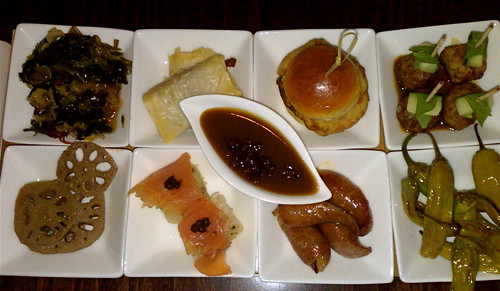
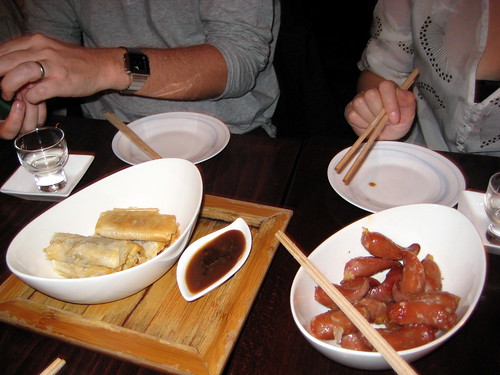
We arrived and ordered a sample plate of the mains on offer and a sake sampler.

101020081175

101020081171

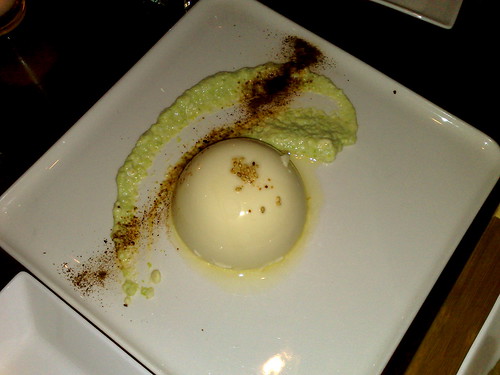
And a large quivering mass of tofu.
101020081176

We then ordered a huge bottle of sake and silliness and hunger ensued.

The sampler and tofu weren't enough for four people so we decided to order extra of the samples which everyone liked. Unexpectedly, it wasn't tofu.

At this point tofu ceased to suffice as a drinking snack. We gave up and ordered full portions of the sausages and eel.

2933582780_f943efceb5_b

My stomach groaned. I'd promised it tofu and spring water and instead showered it with sausages and sake.

Things only got worse after an outrageous kareoke evening, and a taco truck on the upper west side at 2 am.

My digestive system and I are slowly regaining trust in one another, but its a relationship that may take some time to mend

Shake Shack Wobble Test for Health and Vitality

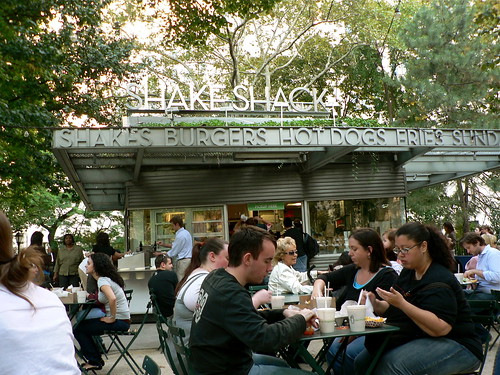
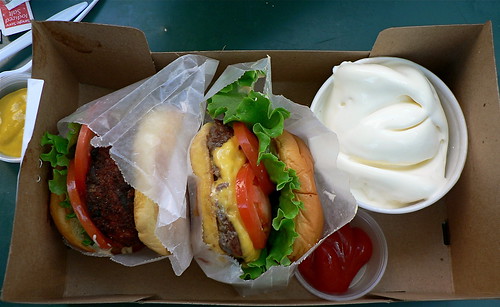
So when you go to Shake Shack and stand in line for 30 mins to an hour and finally order your order hamburger, shroom burger, and frozen custard.... and before the staff hand you over the vibrating electronic device that "shakes" when your order is ready....ummmm.......you might want to try doing a little shake yourself a la Homer Simpson. If for instance, you wiggle yourself and your fat continues to wobble say five to ten seconds after you've stopped exerting yourself......well you might want to rethink your lunch choice, just saying...you know...for your health and vitality.

P1140623

I'm not being mean, just honest, really.

If your wobbles are minor to non-existent, if say you are a Japanese tourist, go for it. Get the lot, guzzle down a shake burger, fries and custard. Why not try a shake shack shake too while your at it. I'm sure the shakes are great.

If however, your not quite hideously obese but could stand to loose a few squishy bits, as in my case, and if you promise to atone big time, then my advice is skip the fries, (they're just fried potatoes you know, you can live without them) order a 'shroom burger and share a small tub of frozen custard. Hock's shake burger is just a burger in my view, but the 'shroom burger was crispy mushroomy, cheesy and good. The frozen custard was dense and delicious. Follow with brisk walks all over NYC.

P1140607

Picnics are the new brunch

Have you noticed since the global economic crisis how magazines and op-eds in lifestyle sections of web pages and other glossies have begun re-spinning the activities of poor people into the new "it" thing, so staying in is the new going out, hillbilly is the new hipster (note to plaid wearers) and locally brewed beer is the new champagne.

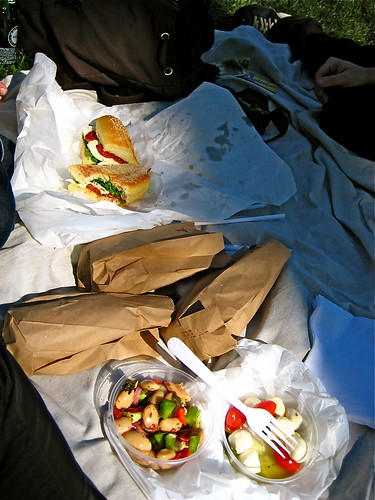
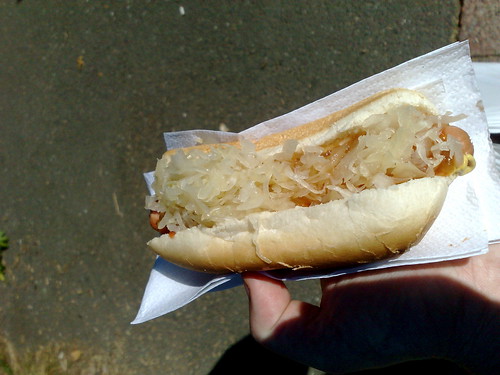
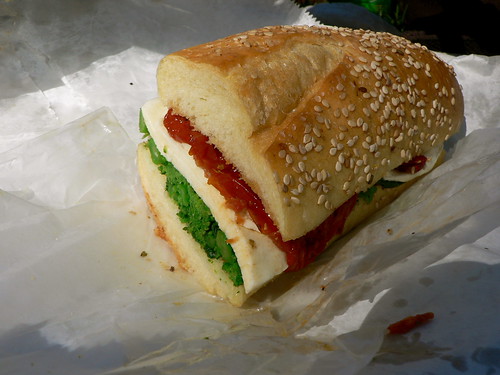
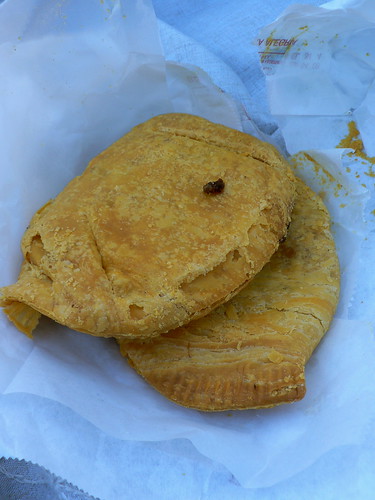
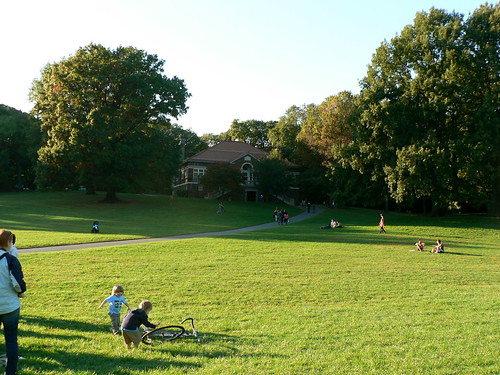
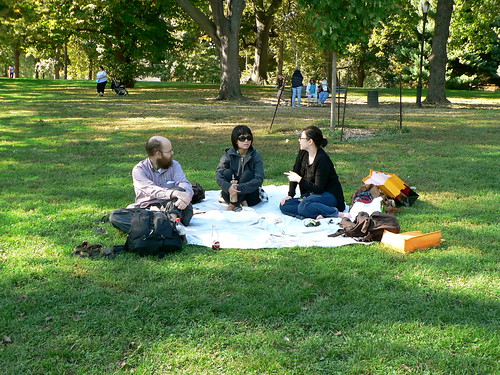
So picnics are the new brunch. Who said? Me.....why spend $50 bucks in NYC or more on a flashy brunch when you can sit in the park in Brooklyn, possibly get arrested for drinking a beer in public and eat hotdogs, broccoli rabe and mozzarella sandwiches, jamaican meat pies and drink organic cola and beer.

2932828285_4dfbe74d3a_b

111020081182

P1140752

P1140755

The best spot in the park, next to the public loos naturally (or "comfort station" as it was so prudishly named). You can even fall asleep in the sun on the grass, something you can't do at a fancy schmancy restaurant. Other people's children are far less annoying in a park.

P1140768

Here's our hillbilly/hipster picnic

P1140758

What comes next I wonder? Will Polish be the new French or Spanish? Polyester the new cotton? Fingers the new cutlery? Poor the new rich? Once again I find myself at the forefront of cutting edge trends. Lucky me.

Phil Lees - Food Warrior

According to the Melbourne Age


FOUR days spent steering a motorbike north from Chiang Mai along the Burmese border along dangerously snaking roads must have made food blogger Phil Lees challenge his actions. Surely, he questioned the madness of making a white-knuckle, eight-day return trip through bamboo-covered mountains to slurp one bowl of khao soi soup? In a word, no.

"I think, at some point, in the trip it just tipped over the edge," explains Lees, creator of Cambodia's first street food blog, http://phenomenon.com.

After three years in Asia, he recently returned to Melbourne and now writes a food blog, Mouthful, for SBS online. "Suddenly, we weren't going to see anything any more. We were just going to eat."

So when a Cambodian friend tipped him off that some of the tastiest khao soi came from a nondescript joint near the entrance to Mae Hong Son's market "a few lazy days on a motorcycle away", well, what choice did a culinary crusader have?

To this day, Lees says, that bowl of coconut creamy curry served over flat egg noodles and melting-off-the-bone-tender beef, with a tart complement of pickled cabbage, stands uncontested as the best bowl of noodle soup he's eaten. Welcome to the world of the food warrior. No dish too abstract, no taste too challenging and no geography too impassable, these obsessives hunt out the best of the regional, the seasonal and the unusual in their journey to uncover the heart of foreign cuisines. Leave the guide books to the masses, they say, donning their metaphoric khakis - there's a whole world of food experience out there and we're going to hunt down every delicious bite.
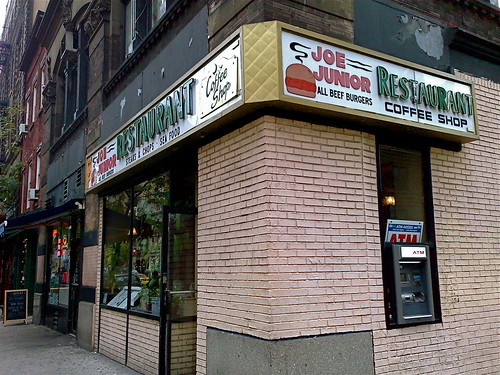

I wonder if this is the same as Hock dragging me half way across town to eat a crappy diner breakfast at Joe Juniors in NYC just cause he's read about it being good by some hack on the intertubes....does half an hour on the subway and digesting half a pound of pure fried American fat at 9 am in the morning count as hardcore? Can we join the food warrior club too?

051020081095

051020081094

Panisse Passé? Alice Watery Applewood

Here's a new idea....Chez Panisse is passé

GASP!!!!!!!

I took the train to Berkeley, less than two hours from Davis towards San Francisco. I checked in at the French hotel and dined in the restaurant across the street. We are talking about Alice Waters’ place, Chez Panisse a restaurant well known to the readers of this blog and in-flight magazines.

There is the formal restaurant downstairs (fully booked) and the café upstairs (a late table was available). I had wine made of Zinfandel grapes.

I took the US$29 fixed menu. It had a garden lettuce salad, spaghetti alla Norma with eggplant, tomato, basil, and ricotta salata, and a Concord grape sherbet with roasted Thompson seedless grapes and langues de chat.

These were the variety names on today’s menu: Concord grape, Thompson seedless grapes, and Little Gems lettuce.

And these were the farm names on the menu: Cannard Farm3, Andante Dairy, Soul Food Farm, Marin Sun Farm, Lagier Ranches, and Frog Hollow Farm.

Terroir trumps agrobiodiversity at Alice’s place.

It is a good restaurant. It is very French. The waiter spoke of terroir as if his name were Claude Duchateu. It is very cheap for a famous restaurant. It has a local twist to it. The food is good. But is mainstream now. The menu in the Davis Best Western Palm Court was not that different.

I suppose it is fair what everybody says, that Alice created some sort of revolution. From the wasteland of the American diner to Good Food. Just like her neighbor Alfred Peet transformed mainstream American coffee from diluted sewage to the best coffee anywhere save (perhaps) Italy. But that is ancient history.

But, just for your information, Chez Panisse is passé now. Go look somewhere else. I have heard of an underground restaurant movement in New York.

Chez Panisse is sold out every night, I think. Alice can experiment. But she does not. She chooses the middle of the road. Their produce comes from “farms, ranches, and fisheries guided by principles of sustainability” but the majority of entrees (main dishes) are a fish or meat dish.

Chuck out the meat. Serve different varieties of other veggies than tomatoes (even the Andronico’s supermarket across the street sells heirlooms). Use something locally evolved rather than merely locally grown. The native Californians used hundreds of edible plants.4 But no miner’s lettuce or acorns on the menu of the Queen of Slow Food. Come on, Alice, surprise me!
Source: Robert Hijmans Agricultural Biodiversity Website

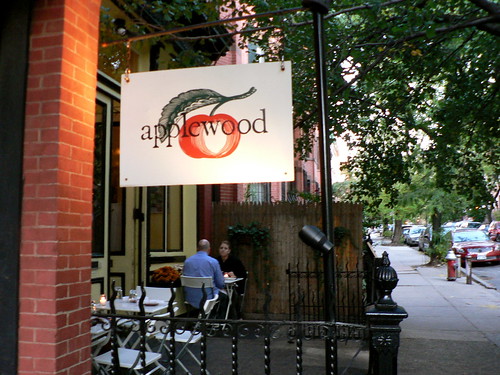
Hmmm, so where can slow food and "locavores" go from here? A good point indeed since the restaurant business is so competitive one does need to constantly be redefining ones niche in order to add novelty and therefore value. It is essential to maintain the buzz.....and with more and more restaurants serving Alice Watery style menus.....such as Applewood in Brooklyn I'd have to agree with Robert.


P1140786

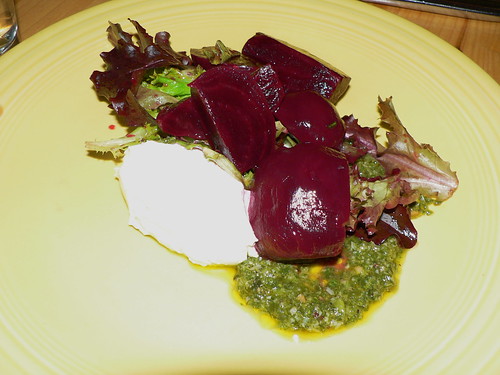
The meal we had here was not astounding. While everything was well cooked and tasted nice it was simple and I must say that aside from the price tag there was precious little appreciation to be had in eating organic local beets and salad. The food was good, or better yet "nice".

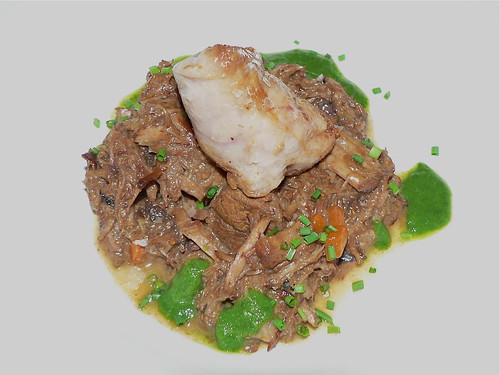
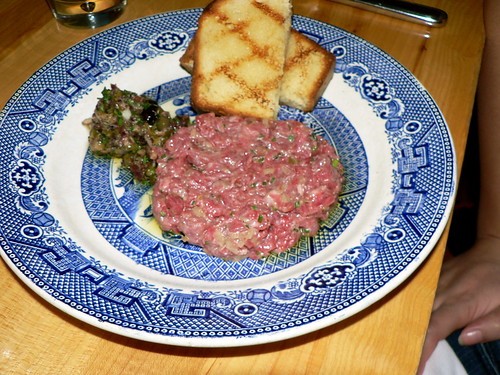
Applewood, like Chez Panisse is a farmer to restaurant type deal. There is organic/ fairtrade hand wash in the bathrooms and the tables were adorned with vases of fresh cut thyme which I snapped off "a la Thai style" and added to my under-seasoned beef tartar (I asked for extra chili but they wouldn't give it to me)

The bill around USD$80 including wine.

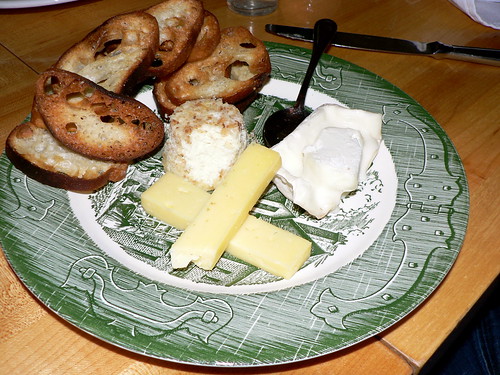
I had beets, the tartar and "artisinal cheese selection" to finish

Beets
P1140795

Beef
P1140798

Cheese
P1140807

I was too busy talking to notice what other people ate....but here are some other photos

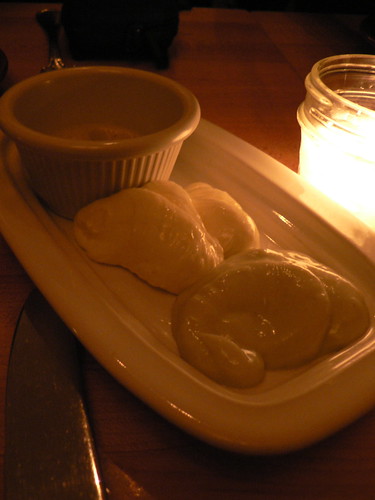
Delicious selection of handmade butters and dips to start
P1140793

Maine Lobster thingy
P1140796

???
P1140797

???
P1140794

???
P1140799

Chocolate Ding Dong, as Hock likes to call them....always a crowd pleaser
P1140806

So now that most inner city hipster regions of the United States now have their very own version of Chez Panisse what happens?

How much more "in touch" can this restaurant niche get? Should restaurants of this theme, as Robert suggests, go deeper still attaching perhaps scientific names to the menu and explaining the role your food played in an ecosystem? Should they only allow diners to eat a limited portion of meat? Perhaps they should only be cooking off the menu of under-utilised species in line with the principle that eating endangered species is the best way to preserve them.


With some quarters of food criticism already underway against molecular gastronomy , should Alice Watery restaurants be moving towards more sophisticated cooking techniques or furthering the general populaces' appreciation for quinoa?

Or hows about molecular Khmer food....anyone?
The day we left New York was a Sunday, and after a week of eating up and down the American East Coast food chain and checking out the full spread of NYC cuisine, it felt almost like a parting gift from the NY Times gods on high that their Sunday edition magazine section was entirely about food and aptly named "Food Fights". The magazine included some interesting articles on tipping, one about kosher meat and a very long open letter by Michael Pollan (post-productivisms poster boy) to the next president of the United States, Farmer in Chief, as he so optimistically called him.

In the article Pollan argued, pleaded and cajoled for the next president (now we know him as Obama) to rethink the American food system on a grand scale. Pollan called for Obama to:
- move away from oil dependent productivist farming practices that produce mountains of food and drive down the price of food at the peril of the climate, energy independence, American health, farming ecologies and rural communities everywhere around the world
- to move towards "post-productivist" practices and systems based on "alternative" food systems: organic, local, pasture based, humane and above all based on solar power not carbon energy.

The 8 web page long article, Pollan acknowledged that while the industrial food system is indeed a marvel it is inherently unsustainable, and called out the ill-logic of seperating protien production from grain, advocating a move back towards poly cultures rather than subsidised mono-cultures that don't even go into "food" production but low quality calories, animal feed and biofuels. He railed against globalised food economies and warned they are coming to an end. He advocated supporting municipal composting and "perrenialising" agriculture, through solar based grass fed livestock production aimed at reducing meat production and consumption. Although by Pollan's own admission whether or not such a food system would be capable of sustaining the American population is up for debate. Yet Pollan is self-assured it's worth a try, believing that organics can produce same amounts of food, but requires people to move back to the farm. Yes, he supports re-ruralisation and the re-education that would be required to achieve this new American food system (a statement that conjured horrifying images of the Khmer Rouge or China's disastrous past). He advocates decentralised local regional food systems, grants to support farmers markets, reduced food processing regulations and the introduction of local meat inspectors. Pollan believes there should be a strategic grain reserve and a regionalised food procurement system which if the Republicans haven't had enough of smearing Obama as a socialist by now, they surely will be reinvigorated to do so if Pollan's manifesto was ever to be implemented. Pollan also requests the creation of a Fedaral definition of food, which makes "real food" exempt from sales tax. In Pollan's utopia, food stamp cards would double in value when used at farmers markets. We would educate children a la Alice Waters with edible gardens and oil used in the production of food would be on labels. Finally barcodes would include stories of the full production process when scanned.

Well golly!

Now I don't disagree with Pollan that there are some serious problems with the American food system (and this does not in my view mean by extension the whole world's food system, although many people seem to think it does). The noticeable lack of fresh fruit and vegetables and indeed the cost of anything green was most surprising to Hock and I on our visit. A bowl of fruit salad was roughly double the price of a bacon and egg sandwich, which left me with no doubt that their's is a fucked up food system indeed. But does it require radical change?

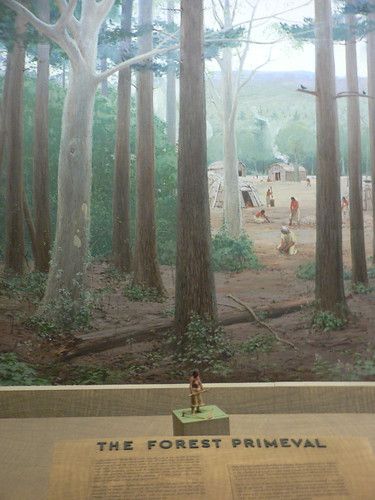
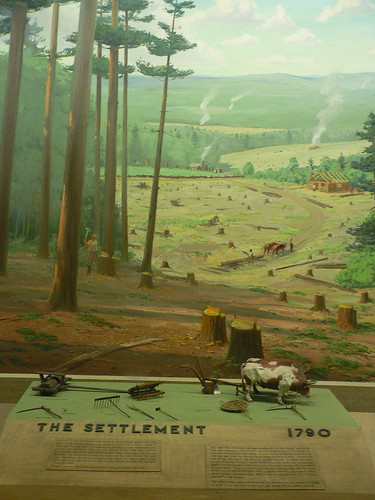
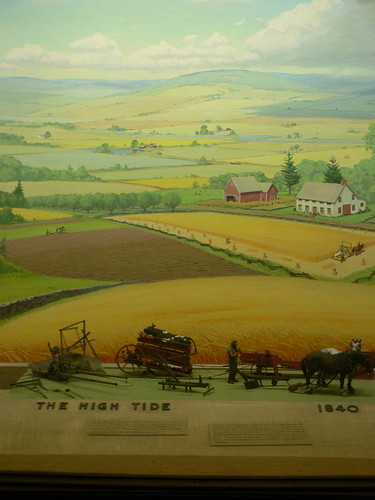
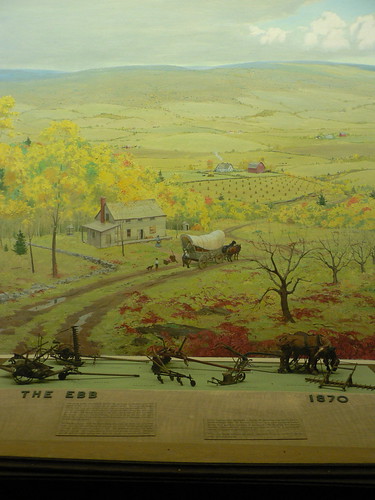
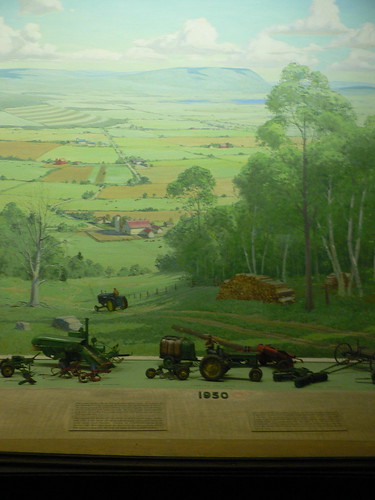
A small insight into the minds of American food radicals came to me on a visit to the Museum of Natural History. (I love Natural History museums. I love looking at rocks and species of bugs stuck to pin boards and the like). The Museum had some pretty spectacular exhibitions, especially the planitarium and whole space area in general. Some big money had obviously gone into funding the space section, as opposed to say the "agriculture" area which presented a uniquely linear, mid-century/ modernist/ productivist world view of agriculture. I'm sure most visitors to the museum don't even notice the exhibit situated in a corridor on the way to the far more sophisticated presentations on evolution and ever-intriguing rocks. Instead the exhibit is so outdated that it could be considered an artifact unto itself, with its dusty old cabinets and Fifties fonts invoking a kind of sentimentality for the good old days of Elly May and Uncle Buck, apple pie and soda pop. Harking back to those pre-diabeties, pre-obesity epidemics days, long before the term "food dessert" could be understood in urban terms and when corn was simply the best thing before sliced bread. Perhaps that is why they keep the dusty lined cabinets which detail agricultural development as a linear process that moves from "primeval forest dweller" (note dark skin colour) to settlement and high production (note white farmers, no slaves present in farm scenes). Maybe they keep it for posterity's sake, or maybe its just because Michael Pollan lives in Berkley.

P1140672

P1140673

P1140674

P1140675

P1140676

I was also much amused by the diagram on soil fertilisation, which depicted in no uncertain terms the benefits of agrochemicals. The smaller grassy mound's title reads "unfertilised" with the large towering grassy mound reading "fertilised". It is quite clear from this and the other exhibits that more is certainly more, bigger better.

P1140677

Which is pretty much where that the diagrams end. The museum's outdated "agriculture" exhibit serves as a pertinent reminder to the fact that very little thought has gone into "developing" agriculture in America by the federal state since the 1950s. Here "agriculture" remains locked in "space" and "time" and with not a hint towards the food fights and furores that continue to rage outside in post-modern America and indeed the globe. Should the exhibit be merely extended on beyond its current displays, what would we see? Perhaps there would be landscape paintings of the horrors Pollan describes....corporate farming in America....perhaps an exhibit devoted to explaining the problems associated with mono-cultures? Maybe an exhibit with smell-o-vision where one can sense they are approaching a pig or cattle feed-lot? Further still, some particularly radical curator might have taken delight in scaring the hundreds of children that tour the museum each day with an exhibition on the modern abbattoir? Maybe they could just have one horrible black stinking miniature scale pit to represent the black hole that Pollan believes American agriculture has become. Perhaps they would have an exhibit filled with cheap Mexican labour picking fruit, or even a diorama of small-scale african farmers starving due to global agricultural commodity dumping by countries like America that compromises their economic viability and puts food sovereignty of developing nations at risk.

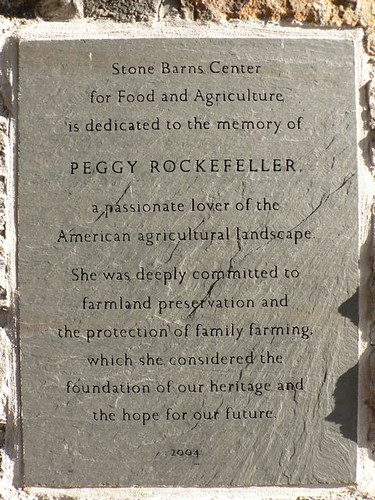
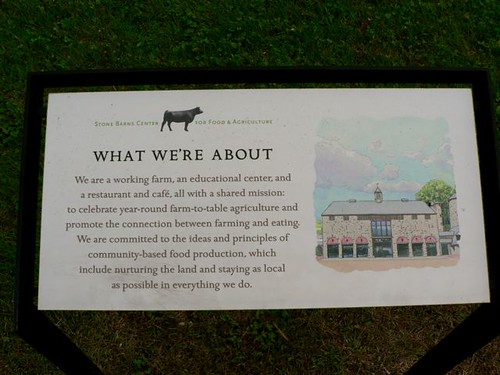
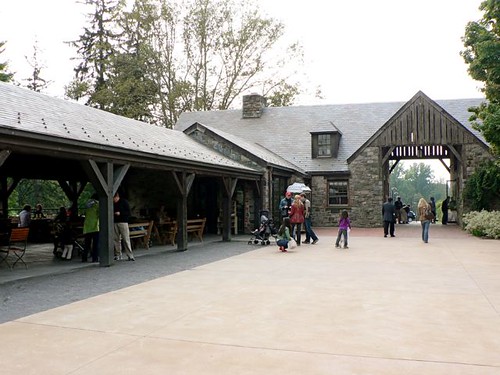
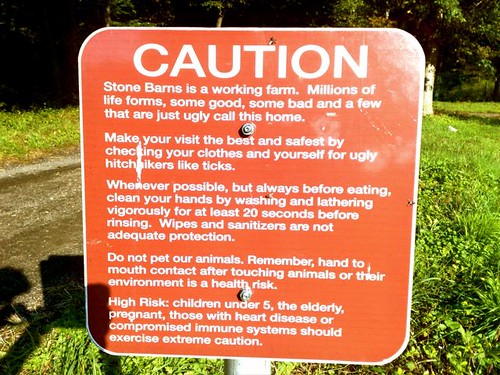
But if the exhibit extended further still and took the "agriculture" exhibit to its present day Micahel Pollan ideals, perhaps we might end up with a miniature version of Stone Barns a new type of "post-productivist" farm located half an hour by train outside of New York in a place called Tarrytown. A model farm or vision of what some people want agriculture in the United States to be like today. Something that looks very "Alice Watery" indeed.

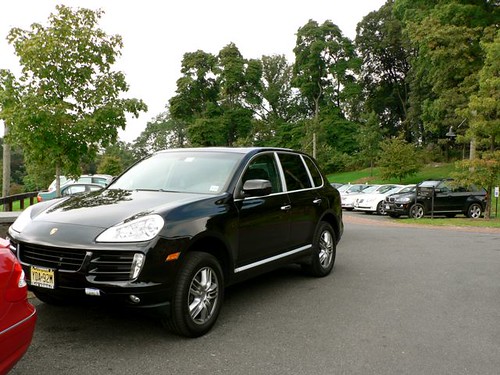
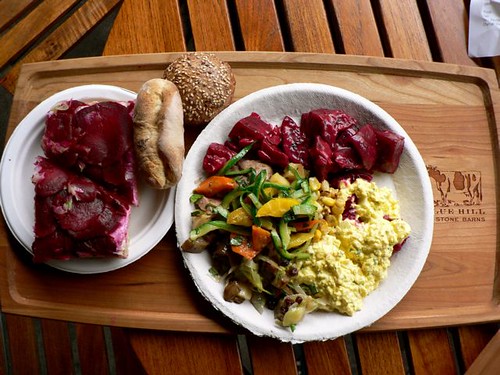
For this we would need diorama of a medium scale diversified farm, including upscale restaurant with resident "celebrity chef". As such a medium scale farm these days can barely be economically sustainable, true to real life the exhibit like the farm should be funded by the Rockerfeller Foundation. Multiplicity here is the key, as mentioned by other rural sociologists of the developed world. Thus this farm would also have a cafe, walking tracks, events room and more. It would be more than a farm, but instead an educational centre and tourist attraction. There would be mini porches and BMW's in the car park and white people riding horses. There would be tiny signs everywhere that educated people as to what garlic chives look like and spelt out proper farm place behaviour. There would be tiny home-made jams and pickles for $10 USD a jar and overpriced egg and beet salads.

P1140457

P1140440

P1140425

P1140442

P1140418

051020081105

If the Museum of Natural History were to continue its agriculture exhibit in a linear fashion true to Michael Pollans views, it would go from Primeavel Forest Dweller to the 1950s, through to the horrors of industrial agriculture and on to Stone Barns and beyond to the full utopia. Food systems would be presented as an either/or dilemma, a binary choice between evil corporations or medium scale organic farms filled with re-educated workers. Or perhaps the Museum should just trash the whole section in favour of something far more interactive, diverse and inclusive? Perhaps the Museum should, more sensibly, rethink the whole idea that agriculture and food systems are in some way linear and instead represent them as mixed diverse systems that at times need of intervention to ensure peaceful coexistence. Where, industrial and local food are all deployed to ensure resilient food systems that provide both quantity and quality to all people at all budgets whether primeval forest dweller or New York foodie hipster.

For sure a week of wandering around New York and craving more green things gave me an understanding of why many Americans are increasingly radical about their food politics, but utopians and binaries always create the need for radical opposition.

Blogger Templates by Blog Forum