Showing posts with label seasonal food. Show all posts

Ich bin Gans voll: the Christmas work party

xmas

The pleasures and calorific terrors of Christmas eating here in Germany are truly hard to resist (I was encouraged at my Iyengar class yesterday to see that even the most dedicated of yogis had developed seasonal paunches).

As usual, December has been a month of heavy eating for me, but our work Christmas party two days ago was the cherry on the cake. Three colleagues arrived from Munich with a whole sack full of pretzels from cult bakery Hofpfisterei and boiled up a pot of Bavarian weisswurst with sweet mustard.

Then, a couple hours later, we all set off from the office by foot, through the snow, for an evening at a local organic cooking school which holds classes throughout the festive season. The classes are more of an exercise in group bonding & eating than anything, though they do give you some pointers on chopping red cabbage. For minimum stress, they take care of putting the goose in the oven a couple of hours before your group arrives, so you can concentrate mostly on getting drunk.

Knocking out out comfort food classics with workmates was a good time, even though we usually have very different tastes: some people watch their diet, others eat cake every day, some love putrid french cheese, others can't stand any cheese apart from the stuff on pizza, & one is an orange food phobic except when it comes to Fanta. German comfort food brings everyone together.

xmas

We were fitted with aprons, served wine or rosewater bubbly and a toasted coconut and lentil soup as a starter, then set to work peeling parsnips, chopping a massive pot full of red cabbage, and mixing ground almonds with rosewater & honey for chocolate-coated marzipan bonbons, at three different workstations (one for salad, and seitan for the vegetarians, one for hot side dishes, and one for dessert).

xmas

Within a short space of time, fingers stained purple from the cabbage, we were feasting on the goose with psychedelic-hued 'rotkohl' in a buttery-textured apple juice and spice reduction, potato-parsnip-horseradish mash topped with crunchy candied pumpkin seeds, and a warm 'chutney' made of chopped chestnuts with rosemary and organic store-bought marmalade. Followed by the dark chocolate marzipan bon bons and a frozen parfait that our dessert team had made just a couple of hours earlier from whipped soya cream and crumbled spicy 'lebkuchen' gingerbread pieces.

To me, it seemed the soya cream didn't leave the same sour, sick sensation in the stomach that large amounts of regular cream tend to. So I felt it was my duty to indulge in multiple servings, each one doused with a spicy warm plum compote.
I'm sure I've never eaten so many ostensibly wholesome calories at one sitting.
But you know what they say. Gluttony only comes once a year.

xmas
Denis sorting 'postelein' leaves for the salad.


xmas
Erik the chestnut-preppin' weapon.

xmas
'Bonbonbaklat', said Jens.

xmas
Yannick's brother Sven has 3 michelin stars. Yannick doesn't eat a lot, but he's pretty good at cutting cabbage.

xmas
Genesis of rotkohl.

xmas

xmas
Christmas is coming, the Goose is getting fat (me too).

xmas
Lebkuchen parfait penitence.

A Few of My Favourite Things pt2

taai popje

This Taai Popje traveled all around the world in order to have me bite its head off. My sister bought it in a Dutch store in NZ and sent it to me in Germany. The chewy, not-too-sweet coriander-infused Dutch gingerbread is quite different to the more biscuit-like German lebkuchen (also delicious). It melts to a pleasantly sticky-gluggy consistency in your mouth.

wulf's handcut spätzle noodles

There aren't many traditional German dishes that can make me seriously salivate just by looking at a (crap phone-cam) photo of them. Maybe it's my cheese-loving Dutch blood, but our boxing day meal of Swabian Kässpätzle (with vinegary potato-cucumber salad for added carbs) inspired absolute devotion in me. It's a treat I'd definitely recommend to anyone who's skeptical of German cuisine.

Our workmate Wulf comes from the Swabian-speaking area of Baden-Württemberg, where this is a traditional dish. He and his girlfriend Dagmar made the noodle dough and chopped it freestyle off a board in thin strips into the boiling water. Then they baked it in a glass casserole dish coated in a not-too-greasy mix of emmentaler and aged british cheddar cheese, topped with very thin strips of toasted onion.

If angels in heaven eat mac 'n' cheese, I am sure it tastes exactly like this.
Here is a recipe - just swap in your favourite type of cheese.

For dessert Wulf served us delectable baked apples stuffed with real marzipan (different to the stiff white stuff on wedding cakes), topped with whipped cream and a drizzle of rum.
If I was in the market for a heart attack, I'd eat this menu for a month. It could be a nice way to go.

flammlachs1

I am a kitsch-hound and a christmas aficionado, but I do have standards. There's only one Christmas market in the world for me, and it's the Market of Angels on Neumarkt square.

The market by the cathedral is too fake and touristy. The market on Rudolfplatz is too trashy (they sell mobile phones and young hoodlums ride a carousel that includes a motorbike and a police car). The market at Stadtgarten is polite and bourgeois, a haunt of Cologne's liberal elite, where everyone seems to wear brown.
But the market on Neumarkt is just right.

I can't imagine going to these places to buy souvenirs - but to drink two hot mulled glühwein under twinkling star lanterns in the trees is something I actually look forward to all year.

Importantly, the christmas market on Neumarkt also has yummy things to eat. For example, egg-spiked potato pancakes with applesauce. Or the stall selling crispy skinned flame-grilled salmon (nailed to boards over a fire), which drips its grease into soft white rolls smeared with creme fraiche and a lettuce leaf (see pictures above and below).
Our pescatarian friend Celia, visiting from Australia with her winking Irish boyfriend Dave, was quite a fan of these.

flammlachs2

Another treat from the Neumarkt christmas market is the Flammkuchen (everything delicious here seems to be born of the flames).

From the Alsace region, similar to a pizza, the brownish sourdough base comes hot from the oven – topped with creme fraiche, little specks of bacon (check the pun: speck means bacon in German) and thin strips of onion. You can alternatively choose a less traditional, but still satisfying, mix of vegetables and salty grilled cheese. This is a market that (unusually) caters well to vegetarians.

flammkuchen

It is always tragic when the Christmas markets close for the season, leaving behind a quiet grey snow slush in the absence of twinkles. The stone angels are chained up on trucks on Christmas eve, with a poignant smell of aniseed candies floating on the air. life is all about goodbyes and new beginnings. In this case, a new beginning of me not eating deep fried 'reibekuchen' potato pancakes with apple sauce every other day (until next christmas of course)

Gourd Almighty

autumn1

Usually we're away in autumn, for work. So I have come to associate this season with the twilight gusts of wind, rivers of shoppers and twinkling nightlife of larger cities. But this year, for the first time, we've spent most of Autumn (minus a couple of weekends away) at home in Cologne.

Here are a few of the seasonal rituals we've enjoyed:

federweisser

Federweisser: young wine. Like a nice cider or soda, with a slightly vomitty fermented edge. It's a must!
(Nobody I know drinks it with onion tart, so its rumoured 'tempest in the stomach' effect might be a regional thing).

pumpkin jam

Making pumpkin jam.

Turns out jam-making is as easy as pie (...not that pie is really a walk in the park).

I used a ratio of 3:1 pumpkin to apple (two small hokkaido pumpkins and a small bag of apples), and a ratio of 3:1 fruit/veg to brown sugar.
Just boil it up with a bit of lemon and cinnamon, & simmer for about 40 minutes. Add up to 4 teaspoons of agar agar towards the end if you like a jellyish consistency.
You can test the consistency by daubing some onto a plate that's been chilled in the fridge.

Wanted to recreate the delicious pumpkin jam which you can buy from the Viktuellien market in Munich, but will have to experiment further to get that sloppy, pleasantly stringy consistency. I'll also reduce the amount of apples (for a stronger pumpkin flavour) and the amount of agar agar. Maybe I'll add some mango puree to up the babyfood consistency.

This jam is very enjoyable on toast with frischkäse (the less gummy German version of cream cheese) and extra cinnamon.

It's a nice treat to have your own home-made condiments to nibble on, on chilly days. Have also really been enjoying my extra-spicy version of these Dank St pickles, with strong 'nusskäse' cheese.

Home-made tastes good when you're housebound.

DSC_0073

Spaghetti squash. We were introduced to this by my Canadian brother-in-law (late to the game, I know). We like to split in in half, scoop out the innards, then daub with butter, grated ginger, honey and olive oil and bake in a hot oven.

Or use its delicate shell to make dorky halloween photos to send to your nieces and nephews.

autumn2

The Social Construction of Italian Slow Food

Italians love to tell you how great the food in Italy is. They go on and on about, fresh cheese this, seasonal that. They initiated the Slow Food movement for crying out loud. Taken at face value it seems that Italians have forever been in step with nature, seasonal produce and local artisanal producers. This is just one of the many ways that Italians not so subtly demonstrate that they are well, better than us.

Apparently, however Italian food historian Montanari (1996:161) begs to differ.

Montanari emphasises just how much producers and consumers have traditionally seen seasonality as an affliction. He says 'symbiosis with nature and dependence upon her rhythms was once practically complete, but this is not to say that such a state of affairs was desirable; indeed, at times it was identified as a form of slavery'. This was especially true of the poorer sections of society, where consumption of foods such as grains and legumes was the norm precisely because these foods could be easily conserved. Access to fresh and perishable foods - such as vegetables, meat ad fish - was the luxury of an elite few. This, 'the desire to overcome the seasonality of products and the dependence on nature and region was acute, though the methods for doing so were expensive (and prestigious); they required wealth and power'. Montanari therefore concludes that it is 'doubtful whether we can attribute either a happy symbiosis with nature or and enthusiastic love for the seasonality of food to "traditional" food culture


In Morgan, K., T. Marsden and J. Murdoch, 2006. Worlds of Food: Place, Power, and Provenance in the Food Chain. Oxford: Oxford University Press, pg, 9

New Zealand Christmas Envy

Now I am feeling home sick

My two sisters who still live in New Zealand just sent me these photos of their Christmas fishing day in Thames

They had a morning swim in this river

DSC03894

Stayed in my older sister's girlfriend's house in Thames

DSC03915

Caught fresh scallops

DSC03922

and lots of snapper. This is my youngest sister with the fish

L1000128

I'm sooooo home sick right now

Monkfish steamboat at Hotei-san

It's a bit early to start thinking about winter goodies, but since Maytel and Hock asked for restaurant suggestions in Tokyo in October... here I'm throwing my two cents.

If you'll be visiting Tokyo during the cold months, and have a taste for good seafood, monkfish steamboat at Hotei-san is my recommendation.

Hotei-san is located in good ol' downtown Tokyo, just fifteen minutes walk away from the world famous Tsukiji fish market.

When you make a reservation (a must, because they are usually fully booked during the season), you just tell them the headcounts.
Once you are seated on the day of reservation, it just starts!
They only have one menu, which is sashimi and monkfish steamboat course.

They'll first give you all the big cuts of sashimi plate with heaps of uni (sea urchin roe) and some starters including their lovely sesame-arrowroot tofu (drinks are separate):
Needless to mention the sublime quality of sashimi given the proximity to the Tsukiji fish market.


Then the huge steamboat of monkfish cooked right in front of you in a clay pot:

The orange stuff is the huge load of monkfish liver, which some people refer to as "ocean foie gras". They load it on top of the pile of monkfish meat, guts (which is considered even tastier than its meat) and vegetables and give you a chance to taste it raw before they put the lid on and cook it all up. Apparently it is not a very gout-friendly food.

After you eat and eat and eat and eat, they'll finish you up by throwing rice into the broth to make a rice conge. By the time you happily leave the table, you are about to burst.

It's a lot of food, so go hungry, by all means.

It's very local, if you don't speak Japanese, have your hotel help you make a reservation unless you have a Japanese-speaking friend helping you out.

Hotei-san
3-9-7 Tsukishima, Chuo-ku, Tokyo
03-3531-5200
Three-minuts walk from Tsukishima subway station, in the Tsukishima shopping archade (also famous for tons of gooey cabbage pancake restaurants).
Open 17:30 to 22:30 during October to March (they are also open during non-monkfish season for something else).
Closed on Sundays and national holidays.
Approx. 5,000 yen/person for the sashimi/monkfish steamboat course, drinks separate.
Reservation (from two people up) is mandatory.

Skippy and Big Bird's Demise: Kangaroo Brains in Emu Fat

Exhibition of old Australian cookbooks now on at the State Library of New South Wales


SYDNEY (AFP) - An exhibition of historic Australian cookbooks has revealed the tastes of the country's pioneers, including recipes for bandicoot, kangaroo brains and black swans.

The curator of the State Library of New South Wales exhibition, Pat Turner, said the cookbooks showed how local cuisine developed from early days, when most Australians relied on British staples with a few curiosities thrown in.

"It's been very popular," she said. "Lots of people are very interested in cookbooks, even if they don't do much cooking themselves."

In "The Antipodean Cookery Book", first published in 1895, Mrs. Lance Rawson has a stew recipe with listed ingredients including a dozen parrots "well-picked and cleaned."

Even less appetising is a recipe in Australia's first known cookbook, dating from 1864, for a dish called "slippery bob", consisting of kangaroo brains mixed with flour and water then fried in emu fat


Indeed, if Australian's reflected on this and changed their eating habits back to kangaroos then agriculture here would probably get a whole lot more sustainable. As Gary Paul Nabhan book, “Renewing America’s Food Traditions: Saving and Savoring the Continent’s Most Endangered Foods” revealed eating local species is actually a great way to protect them.

Link

White Bait - New Zealand's Caviar?

$50 white bait

For Hock's Mum's birthday we bought her some wine glasses, a razor zester and 400 gms or $50 NZD worth of South Island whitebait....she was thrilled....Hock made the traditional NZ speciality for her...white bait fritters and the embryonic fishes were drowned in an egg and flour batter and lightly fried and served with lemon.

I relinquished my fritter to my mother in law, knowing what a treat it was for her...personally I've never really understood the NZ fascination with whitebait fritters....to me it just tastes like fish and egg

Whitebait or Speedbait? Jury to decide.

From the amazing newspaper that is the NZ Herald.

A chef will give evidence in a High Court trial in Christchurch New Zealand to support the crown's view that when alleged drug dealers were talking about the ingredients for whitebait patties, they were really discussing preparing methamphetmine for sale.

Two months of telephone tapping, interception of text messages, and surveillance under the police's Operation Dolmio has led to five people being on trial on charges of conspiracy to supply the class A drug.
The phone intercepts include the surprise query by one accused dealer asking how much "flour and sugar" to use for whitebait patties.

Another of the alleged conspirators tells him to use one egg and 8g of whitebait for 10 patties.
Crown prosecutor Anne Toohey today told Justice John Fogarty and the jury that the chef would be called to give evidence of the effectiveness of that recipe.


In fact, she said, the discussion was about "cutting" pure methamphetamine with dextrose to reduce its purity ready for sale.
All five accused have denied their involvement in a conspiracy to source the drug from two men in Auckland, transport it to Christchurch through an inter-island truck driver who was making regular trips, and cut it and retail it in Christchurch.
Miss Toohey said the telephone intercepts would be played to the jury and they would be shown the text messages exchanged. The conspirators often used slang terms, street names, or their own code words for the drugs.
"A drugs expert will tell you about the various types of names that are typically used for the drugs here. At the end of the day, it is a matter for you to decide what they were talking about."


Phil introduced me to the HBO series The Wire
a while back making this pretty believable.


You have to break a few eggs to make a White Bait Omelette
20070814163349-1187066029.jpg
Photo: Kings Fish Market.co.nz

August Food Festitivies

August brings a new month of food days and festivities

The list is extensive but here is a few of interest

August, 2007 Sardine Festival
Kalloni, Lesvos, Greece
During the first week of August, the residents of Kalloni are to be found celebrating their most famous product: Kalloni sardines. On these days you can enjoy delicious sardines, accompanied by lots of ouzo and the sounds of local musicians. Traditional dancing and high summer spirits add to the festivities.

August 2-6, 2007
Lusaka, Zambia
The 81st Zambia Agricultural and Commercial Show
The show is the climax of district and provincial agricultural shows, which are held in the proceeding eight weeks, and so only the best of the agriculture products grown by small-scale farmers are finally exhibited at the show.

August 4-5, 2007 4th National Conference on Pulses & Related Industries
New Delhi, Delhi, India
Hotel Ashok

August 5-9, 2007 ACFSA International Conference (More Prison Food)
Ontario, California
Association of Correctional Food Service Affiliates (ACFSA)

August 7-11, 2007 Great British Beer Festival
Earls Court, London, England

August 10-12, 2007 2007 Humungous Fungus Fest
Crystal Falls, Michigan
Crystal Falls is "Home of the Humungous Fungus", perhaps the world's largest and oldest living organism. It covers 38 acres beneath an Iron County forest near the Wisconsin border. It is believed to be 1,500 to 10,000 years old and weigh about 100 tons - about the same as an adult blue whale. It is the species called Armillaria Bulbosa and the mushrooms it produces are commonly called "honey mushroom."

August 10-12, 2007 1st Annual Delmarva Crab Festival
Milton, Delaware
The Delmarva Crab Festival is all about food, fun, education and the future.

August 11-12, 2007 Chilli Fiesta
West Sussex, England UK
250 plus chilli varieties, 80 plus exhibitors, fiery foods and tastings, growning demonstrations, chilli plants on sale.

August 15-19, 2007 Delcambre Shrimp Festival
Delcambre, Louisiana
Always the 3rd full weekend in August. Home to one of the area's most productive shrimp fleets.

August 16-19, 2007 The International Food Brands Exhibition
Amman, Jordan

August 17-18, 2007 Franklin County Watermelon Festival
Russellville, Alabama
Miss Watermelon and her Court reign over the festivities, concert, antique car & truck show. Always the 3rd weekend in August (Fri-Sat)

August 23, 2007 The Joy of Sake
Honolulu, Hawaii
This is the largest sake tasting outside Japan with more than 200 sakes and tastings from over a dozen restaurants. Also San Francisco and in New York.

August 23-25, 2007 ExpoNut International Trade Fair
Istanbul, Turkey
International trade fair for hazelnut and products, nuts, dried fruits and technologies.

August 25, 2007 Dutch Oven Cook-off
Kanab, Utah
Part of the Annual Western Legends Celebration. Winner can qualify for World Championship, $5,000 cash prize money. Contest not judged on garnishing, but on flavor.

August 28-30, 2007 SIAL MERCOSUR '2007
Buenos Aires, Argentina
International and Professional Food Exhibition (every 2 years)

Aug 29 - Sept 2, 2007 IPF 2007
Jaipur, Rajasthan, India
International Exhibition & Conference on Processed Food

Ina's Rhabarber-Quark Cheesecake

Photo Sharing and Video Hosting at Photobucket

While half a world away people are eating hard-won, bluesey noodles, up here in Germany the weather is getting milder and every citizen exercises his or her right to lie about on grass and eat cake.

Our friends Ina & Harry moved house recently, to a nice below-street apartment in a grand iron-gated house in Ehrenfeld (name of this inner city area translates as 'field of honour'). The apartment opens onto a garden with fountain and Hansel & Gretel style pines. Pretty private gardens are rare as hen's teeth here: generally either you live in an apartment, or you live in a village. If you can find an apartment with a garden you are the envy of your friends. There aren't really suburbs in the picket fence, rotating metal washing line, pumpkin patch sense.

The nice thing that means gardens aren't an absolute necessity, is the many sprawling and verdant city parks, which people really do inhabit and use. These parks make Cologne a real joy to live in during summer... there are often small beer gardens in one corner where lights are hung from the trees, but generally it's meandering grass and towering trees and people lying everywhere sunning, canoodling or grilling. It's nice to see public spaces properly inhabited like that and also nice to see such enthusiastic use of barbeques. In case of emergency you can get little aluminium foil takeaway BBQs from service stations which contain a metal grating and charcoal briquettes, and on really nice days you'll be darned if you can find a single sausage left in any of the supermarkts.

Any way you look at it, a garden is a treat. I think Ina & Harry spend most daylight & dusk hours in that garden (I would too!). They are tending seedlings for a giant pumpkin which they say will be made into delicious pumpkin jam.

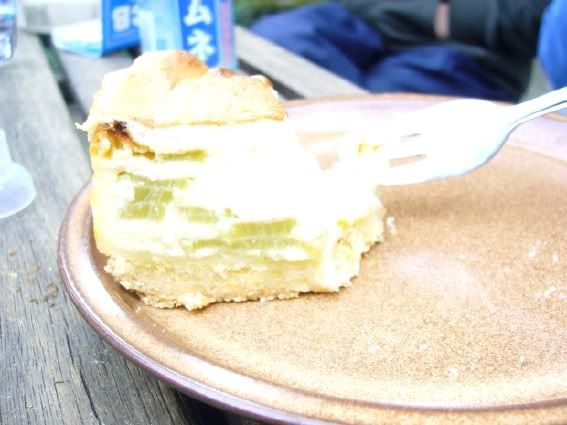
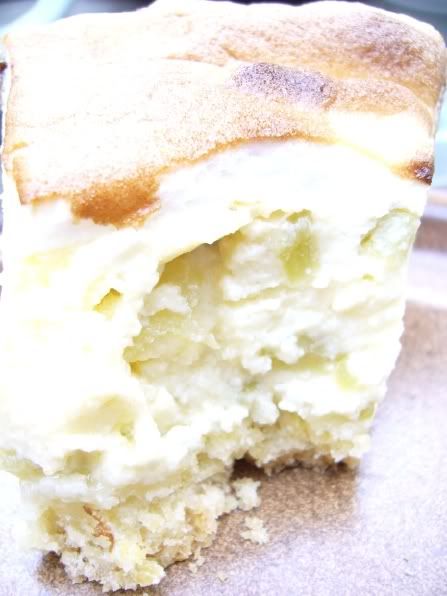
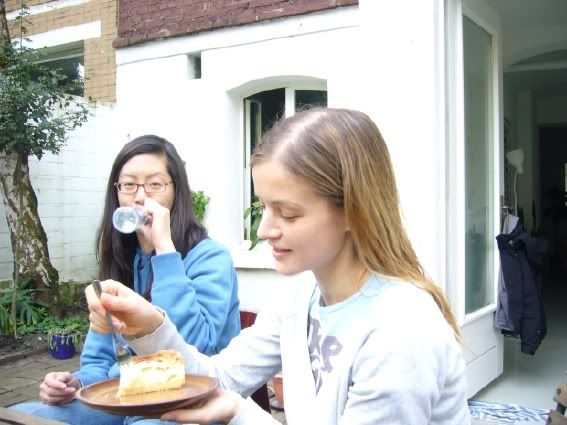
So we visited them on Labour Day for cake and coffee: Ina had made cheesecake with the first crop of rhubarb of the season. Germans are very good at cake! And this cheesecake is really tops, very moissst, maybe because it uses quark instead of cream cheese. Forget every cheesecake you've eaten until now, this is the cheesecake you should henceforth refer to in your cheesecake dreams & imaginings. Really great also because it's really not too sweet.

Photo Sharing and Video Hosting at Photobucket

Ina's Rhubarb-Quark Cheesecake

Base:
200 g flour
75 g butter
75 g sugar
1 egg yolk
pinch salt
teaspoon baking powder

Fruit:
300 g rhubard or other fruit

Filling:
500 g quark
150 g fine sugar
pinch salt
1 packet of vanille puddingpulver or two tablespoons of vanilla pudding powder or good quality custard powder
1 teaspoon of vanilla sugar
1 egg yolk
2 eggs
1/2 liter milk
a little squeeze of citrus juice
1/2 cup of olive oil

Baiser meringue crust:
2 egg whites
4 tablespoons fine sugar


Knead the butter and egg into the base ingredients. Grease a springform
cheesecake pan, and spread the cake-base mix over the bottom.

Cut the rhubarb very finely and spread it over the base. (You could use other fruit like pear or cherries, and you could also spread a little ginger conserve or other jam).

Mix the filling ingredients well and pour over the top.

Bake at 200 degrees for 45 minutes. (Not finished yet!)

Prepare the 'baiser' meringue topping by beating the egg whites stiffly and folding the sugar into them. Spread on top of the cake and bake for another 10-15 minutes. This baiser topping is very thin and just gives a great spongey chewy texture to the top of the cheesecake.

Cool the cake and then put it in the fridge for at least two hours before serving at room temperature.

Best served in a magic garden.

Photo Sharing and Video Hosting at Photobucket

Photo Sharing and Video Hosting at Photobucket

That's the chef on the left drinking 'Ramune' japanese lemonade.

Photo Sharing and Video Hosting at Photobucket

Noodle Exchange

When I was doing field work in Cambodia last year I travelled around a lot in big white four wheel drive landcruisers with Khmer project staff. We generally listened to Khmer music. The older Khmer guys loved listening to a form of Khmer folk music called "talking the blues". It has a Southeast Asian country style to it. Occasionally, they show the music on Bayon TV. It's usually 3 people, a couple of old timers guys and a woman. One plays the Chapei Dang Veng (long neck guitar). They'll talk/sing and intermittently stop for the audience to holler out "Ja ja" or "Bart bart bart" (female and male forms of yes in the Khmer language) - its a bit like when you listen to a live Curtis Mayfield album and the audience yells out in the background "I hear you brother"

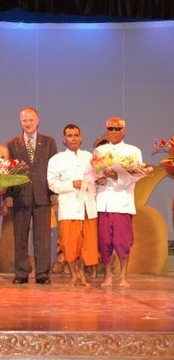
The guy pictured below is considered to be the foremost virtuoso of singing the blues in Cambodia. He is known in expat circles as the Ray Charles of the Khmer blues (I tried to find some online but no luck).

suon penh.jpg

Anyway, on one particular occasion, we were travelling to Prey Veng and listening to some Khmer blues and I asked my Khmer colleague "what is this song about?" (my Khmer isn't that good). Knowing the history of the country, of the killing fields and of the Khmer Rouge, American cold war bombing and repeated invasion and civil war, I expected the response to be about a tale of incredible suffering and hardship. If anyone has cause to sing the blues I thought, it's the Khmers.

"The song is about a man who bought some noodles, from his friend. The noodles are not good. And so he doesn't know what to do. He doesn't know if he should take the noodles back and risk upsetting the friendship or whether he should just keep the noodles. The noodles were expensive and his friend promised him they were great, so now he sings about his worries"

"oh"

And that's when I realised that the appeal of the blues is not to relive horrific events in one's life or the history of the country, but to talk and settle the ethical and moral problems of everyday life and relationships. How to deal with friendship relations and trade, what to do if your sold a bad bunch of noodles.

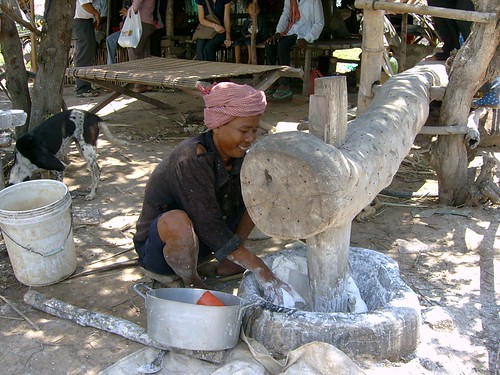
Contrary to common perception noodles are not native to Southeast Asia. Instead they were bought to Southeast Asia by successive waves of Chinese immigrants moving, trading and settling in the region. Rice noodle making as pictured below is labour intensive. It takes about 1 hour of pounding this rice and water mixture to get a kilo of noodles that are sold for about 1000 riel or $0.25. At the other end of the pole 2 small children peddle the log to pound the noodles. Generally most Cambodians make noodles only for the new years, which I think is another tradition picked up from the Chinese. Chinese serve noodles in the new year as they signify longevity.

Chief village noodle maker.jpg

I found generally that in-village noodle making occured in denser villagers with more spare labour and more often in villagers closer to townships. More noodle machines were spotted in villages closer to Vietnam also, where the ubiquitous pho noodle reigns supreme. (This was just my noodle observations, they may not be true).

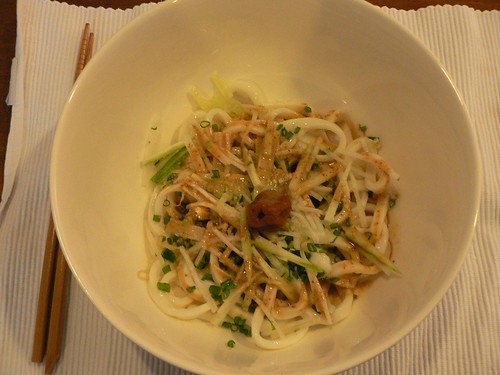
But despite the fact that noodles are not indigenous to Cambodia, this is where I picked up a recipe for one of my most favourite at home noodle dishes. I got the recipe from the owners of my favourite Japanese restaurant in Siem Reap where I often went to dine on their Umeboshi Cold Udon. Luckily I never once was faced with the dialemma of being served bad noodles.

Cold Umeboshi Plum Udon Noodles Recipe for 1 - 2 people

P1090061.JPG

Udon noodles (portion per person)*
Japanese Sesame Dressing
Spring Onion chopped
Daikon raddish (cut into batons)
Cucumber (cut into batons)
Ginger (cut into batons)
Umeboshi Plum

Japanese Sesame Dressing
You can buy this at the store or you can make it yourself. I usually just buy the dressing and then beef it up a bit.

- sesame paste 2 tblspn or so
- sesame oil couple of drops
- minced ginger (1/2 tspn)
- minded garlic (1/2 tspn)
- wasabi paste (little blob)
- mushed up umeboshi
- garlic powder
- sesame seeds whole
- japanese rice vinegar
- little bit of honey or sugar


Boil udon until cooked and plunge into ice cold water. Arrange batons of veges and sprinkle over spring onion. Top with an umeboshi plum and serve with sesame dressing

* You can use cold soba or somen too

It's Spargelzeit!

MySpace Codes


From now until May or June, it's Spargelzeit
(Asparagus Time) in Germany.

"White asparagus grows especially well in the state of Baden-Wuerttemburg, where the "Asparagus Road" passes though the top asparagus producing towns of Schwetzingen, Reilingen, Karlsruhe and Rastatt. Schwetzingen claims to be the "Asparagus Capital of the World" and holds an annual "Spargelfest", the highlight of which is the naming of the asparagus king or queen."

If the 2004 New York Times report still holds correct, right now Polish labourers are busily harvesting asparagus in a town called Zauchwitz.

"Introduced into Germany from France in the 16th century, asparagus arrived in Beelitz in 1861 and quickly established itself as the prime cash crop, with 1,500 acres under cultivation by 1937. World War II and the advent of Communism — this entire area was in East Germany — caused production to dwindle to almost nothing. But a marriage of German capital and Polish labor has produced a remarkable renaissance, and by 2010 asparagus fields are expected to cover 2,500 acres.

At the Syring Family Farm in Zauchwitz, east of Beelitz, where an inflated, 20-foot-tall plastic Herr Spargel greets hundreds of visitors a day, men from Poland do the digging and cutting of the asparagus, and women from Poland feed it into a machine that washes it and cuts off the woody ends. They then sort it by hand and load it into plastic boxes for sale at the farm, in Berlin wholesale markets and to elite restaurants and hotels like the Four Seasons.

Their foreman, Jurek Wojciakowski, also Polish, said they make about 750 euros a month each, about $900, which is three times the going rate back in Poland."

The appearance of these fat, phallic, translucent stems is celebrated as a sign of the end of winter, and it is indeed nice to see restaurants go crazy over seasonal ingredients.

Before cooking it, you need to peel almost the whole stem from the tip downwards. Snap off any woody ends.

Health Benefits

"Asparagus is an excellent source of vitamins K, C and A, and folate, which is good for heart health and helps prevent birth defects. Asparagus also contains inulin, a type of carbohydrate that humans can't digest, however good bacteria in the large intestine can. As such, inulin helps promote the growth and activity of good bacteria in your digestive tract."

Asparagus is a member of the lily family... and this lily-white vege is very nice in creamy potage style soups, though I must say I don't quite appreciate the supposedly delicate flavour of the white variety to the level that is perhaps due. For sautés I still prefer green. (Erik seriously wouldn't believe me when I said green asparagus was more common - that's how dominant the white stuff is here).

I might try this recipe (from epicurious.com) with those imported Chinese black truffles from the biomarkt:

Ingredients

1 1/2 tablespoons Sherry vinegar
1 1/2 teaspoons fresh lemon juice
1 (15-gm) bottled black truffle (1 inch in diameter), finely minced
1/2 teaspoon kosher salt plus additional for sprinkling
4 1/2 tablespoons hazelnut or walnut oil
1 1/2 tablespoons chicken broth or truffle liquid from bottle
1 1/2 lb white asparagus, peeled and trimmed

Garnish: fresh chervil sprigs or chopped fresh chives

Preparation
Whisk together vinegar, lemon juice, truffle, kosher salt, and pepper to taste. Add oil in a slow stream, whisking. Whisk in broth and season with more salt and pepper if necessary.
Arrange asparagus on a steamer rack and sprinkle with kosher salt to taste. Steam asparagus, covered, over boiling water until tender, about 10 minutes for white (4 to 6 for green).
Transfer asparagus with tongs to paper towels and pat dry. Divide among 4 plates, then spoon vinaigrette over and serve warm.

MySpace Codes

Is Bio Besser?

Photo Sharing and Video Hosting at Photobucket

Bio is big in the Bundesrepublik.

When I first arrived here, I stayed with dear friend Lars Vegas
. Lars is a very healthy man: he gets up every morning, eats a banana and goes jogging. My first impressions of German life came from Lars' airy, light-wooden floored apartment, his rosy-cheeked son Tony, and the fact that Lars would hop on his bicycle to go buy organic milk in those nice wide-mouthed glass bottles, Bionade
soft drinks, and always a plentiful supply of Voelkel
juices.

Germany has several different gastronomical identities, so it seems.
There is of course the traditional potato-cabbage-pork-bread-cream variety, such as in days of old when breakfast and dinner could both well consist of a hearty slice of black bread topped with cold cured Blutwurst (blood pudding) and some raw onions, lunch being the time for a serious meal of starchy Knoedel dumplings, braised cabbage, apple sauce and some delicious meat or other. Zum beispiel.

Then (apart from the gigantic middle ground of typical packet-goods and whatever-goes) there's the other big diet trend of organic food, raw delicious mueslis called 'Body Power' or 'Sinner's Träum', and beetroot & apple juice. Eaten by people who wear rose-scented Dr Hauschka mascara.
MySpace Codes


It's definitely not (just) a hippy thing though:
According to Prof. Ulrich Hamm, University of Kassel, 40 to 60 new organic supermarkets open each year and the activities of the discounters noticeably contribute to market growth. (Hmm, note this phrase 'activity of the discounters').

Also according to Ulrich, organic food sales rose by approx. 16 % in 2006 to a good 4.5 billion EUR.

Organic food worth a total of 14.5 billion EUR was consumed in the European Union in 2005, of which 27 % was in Germany alone the most important European consumer market ahead of Great Britain (17 %), France (14 %) and Italy (12 %).

The organic boom started in the 80s, but German consumers were more recently frightened by BSE and GM food, leading them to up the ante. Berlin has over 30 organic supermarkets. I can think of at least five quite big organic supermarkets in Cologne off the top of my head (Erik estimates around 20), while in the trendier areas there are also smaller health food stores on virtually every second street.

Going to a German biomarkt is much more pleasant than going to a regular supermarket (unless you count the fancier aisles of upscale delicatessan supermarkets). The lighting is softer, the food is packaged in a way that says "I care", and the trolleys at our local Basic
supermarkt are these vibrant red plastic wheely toys onto which you can attach the yellow plastic basket.

The veges are displayed in appealing piles... there are many tofu products and many varieties of juice. It's just an ober feel-good experience. (note: ober is more grammatically correct than über)
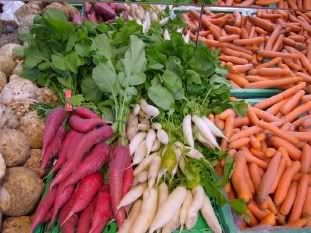
Photo Sharing and Video Hosting at Photobucket

The question that's been lingering on my mind, though, is: is Bio besser?

It looks appealing, it's better for the environment (erm at least we can be sure the stuff that's produced locally is), and a European Commission investigation late last year found that "organically produced food has a higher nutritional value than conventional food."
But is it better tasting? And is it good value for money?

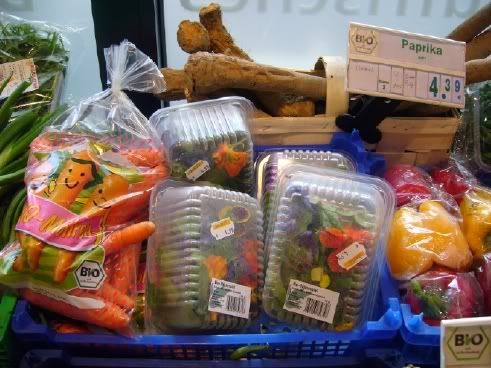
There some obvious big pluses to having a biomarkt on the corner: a good range of grains, a daily chance to feel virtuous. Produce-wise, I do appreciate that Basic has shiny green plastic buckets filled with Schwarzwurzeln
(burdock), and fresh paprika root (see photo above), and cute flower salads, again in conveniant plastic containers.

However the price, as Maytel has mentioned before, has social implications...there's something implicitly elitist about organic supermarkets, I've always thought. The attention to detail and simple, effective packaging in Germany is VERY pleasing to me but the effect is overall consumerist: the shininess and wholesome appeal of goods in those places really tricks you into throwing various small expensive items into your brightly-coloured basket. A tub of 'sultan's freude' cream cheese with dates and spices here, a pottle of berry-flavoured goats milk yoghurt there.

One of the main reasons I end up there each week is for Japanese ingredients: it's a supply & demand thing. There aren't too many Japanese people in Cologne, so if we really need some Mirin, it's gotta come from the Japanese section at the biomarkt. And I do whole-heartedly appreciate that in an emergency I can get a small packet of macrobiotic white miso 'an die Ecke', even if it does cost six euros from Basic.
But it does sort of grate that half their macrobiotic stuff is just barely-disguised repackaged food from Japanese importers: their 30g gold-sided 12 euro boxes of 'macrobiotic' matcha green tea powder turned out to contain a can which still had the japanese print on it and which you can get at the Japanese supermarket in Duesseldorf for 3 euros.
Rant, rant... my feelings about the biomarkt are so complicated. Biomarkt, I do care, I do.

The other day when I took the above photo, in the midst of admiring fresh produce I was suckered into buying one very beautiful punnet of strawberries from France for 4 or 5 euros. They looked so perfect. But when I got them open, one was moldy and the others seemed to lose their sheen before my eyes, developing white-ish soft spots.
Now, I don't like being ripped off: even by wholesome salt-of-the-earth types.
Remember above that Ulrich claimed "activities of the discounters noticeably contribute to market growth"? It seems that even in the world of bio, one is better off not placing too much trust in supermarkets and instead just keep dreaming of the day when you will have enough time to visit markets and buy straight from producers (ahh, like Maytel mentioned, the slow food demon raises its unattainable head).

You know it's all my fault in the end (another food guilt complex): I should be eating only local things that are in season or naturally long-lasting, like those phallic white asparagus (it's Spargelzeit!
), and properly-stored apples.

The charismatic Carlo Petrini, founder and President of Slow Food, spoke at the February 2007 BioFach conference in Nürnberg. The closing report said he "urgently pursued part two of his life's motto again at the opening of the exhibition, at a press conference and in many personal discussions. His passionate opening appeal for top-quality food and against genetically modified food struck the right note in the hearts of exhibitors and visitors."

Top quality!! Due to consumer demand, and with biomarkts striving to feed us South African porcini mushrooms and truffles from China and fucked French strawberries, there's no guarantee of quality: so buyer beware, and don't assume everything bio is better.

The problem at the root of the bio quality issue is Germany's rising organic consumption - such a steep rise in demand that organic food stocks across Europe are dwindling, and forcing German importers to advertise on the Canadian trade website for organic blueberries... organic oats... lord god, somebody send us some more organic maple syrup! We beg of you!

The whole conundrum can be read about in this
article, which contains the sombering paragraph: ""Oats are sold out all across Europe, you can't buy eggs anywhere in Germany and France, and no one knows how consumers are going to get potatoes from the middle of January on."

(So alarmist... I haven't noticed any freerange egg deficit! but then again who knows where they are coming from..Chile or Morocco perhaps?)

While importers claim the mileage doesn't result in lack of quality, I'm skeptical...they surely can't be as fresh ... or maybe big supermarkets are just bad in general - which leads us back to the mysterious activities of the discounters, and my rotten strawberries.

The catch phrase of the BioFach meeting of the international organic food industry in Nuremberg was "It’s the organic mix that counts: trust + health + enjoyment."
I'm sorry, Basic: I don't quite trust you. But I will still buy bio, at least 40-50% of the time.

Blogger Templates by Blog Forum