Showing posts with label Food Nostalgia. Show all posts

Recommended Daily Dosage

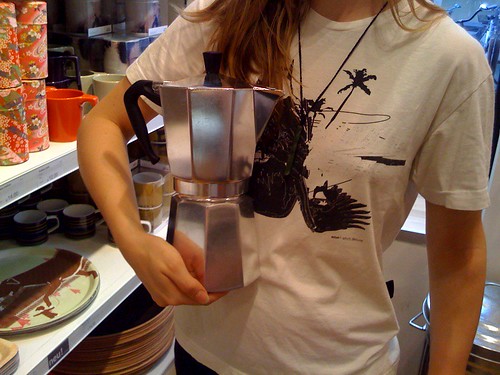
bialetti espresso can

I'm still not sure if this Bialetti stove-top coffee can, seen at Habitat in Neumarkt, is supposed to be taken seriously - but in terms of volume it might represent my daily coffee consumption quite well.

When serious baristas talk about the ideal ratio of coffee grounds to liquid extracted, they're obviously talking about real pump-driven espresso - not these stove top abominations. So let's not bother to try and figure out just how overextracted the grounds in this Bialetti would become.

One of the first 'articles' I wrote for our school newspaper The Flannel was about the characteristics of proper espresso and the history of coffee-drinking in New Zealand's capital city.

It was a tumultuous saga of Swiss, Polish and Italian immigrants, of a hard-bitten lamington-serving cafeteria called the Matterhorn giving way to dutiful Italian espresso machines embraced by hordes of government employees and academics.

Sure, a teenager writing about espresso is 'just a tad' pretentious. But being a student at the inner city Wellington High School is all about skipping school, hanging around Cuba St when you're supposed to be in biology class, snacking on apples and Cookie Time cookies, then bumping into your mates and getting coffees, 'cause you're too old for shoplifting now.

Early on I was dragged to cafés with my mother, where we would look at expensive import magazines or read library books (one of Wellington's good spots used to be the Lido opposite the Civic Square and public library).

Later, when working at a café with a punk chef, a horny gallerist and a gay linguist, I learned to take due care with each cup. A flat white with corn fritters or dark Whittaker's Sante chocolate bars, a heaping spoonful of kiwi familiarity and a dollop or two of sarcasm, please.

I would honestly rather drink a strong stove top coffee or even a strong cup of plunger coffee than a weak espresso. Other forms of coffee can be appreciated on their own merits, I feel, though I am not really down with the cult of Bodum drip as practised in the USA and Japan.

As defined by Lord Jeffrey Steingarten, the predominant flavours should be "caramel, flowers (including jasmine), fruit, chocolate, honey, and toast - but only if you do everything right." (i.e. two tablespoons of 192 degrees fahrenheit water forced through seven grams of finely ground coffee under nine atmospheres of pressure for 25 seconds).

Otherwise, as Jeffrey notes: "One false step and you are totally doomed. One false step and you will never taste the jasmine."
Mid-Century Food - Julia's Caesar

I like every other English speaking media aware person on the planet am currently obsessed with Mad Men. Yes the story line is good, intriguing, but Hock and I are more obsessed with the props, the wardrobes and the food, and gasp, the glassware.

Mid-century furniture has been hip for sometime now, with eames chairs and the like fetching in the thousands, yet to make a serious come back is 1950s food.

But I'm doing my bit.

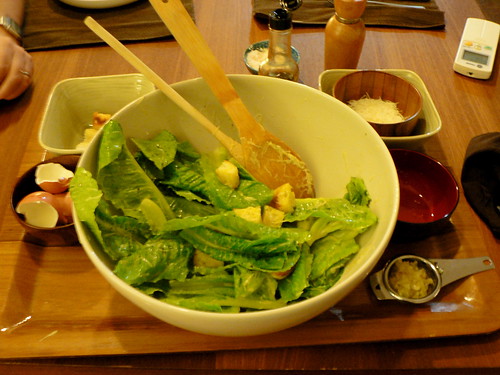
I made for the first time in my life today, a proper caesar salad. I ate today for the first time in my life a proper caesar salad and I'm glad to report it was delightful, moorish and easy. In fact it's so satisfyingly simple it's hard to imagine that this was the greatest salad of its time, but like most things its simplicity is key to its greatness.

I found the recipe here at a site simply called "No anchovies in caesar", a single web page with an excerpt and recipe from Julia Child's Kitchen book, which explains why the kerfuffle.

One of my early remembrances of restaurant life was going to Tijuana in 1925 or 1926 with my parents, who were wildly excited that they should finally lunch at Caesar's restaurant. Tijuana, just south of the Mexican border from San Diego, was flourishing then, in the prohibition era. People came down from the Los Angeles area in droves to eat in the restaurants; they drank forbidden beer and cocktails as they toured the bars of the town; they strolled in the flowered patio of Agua Caliente listening to the marimba band, and they gambled wickedly at the casino. Word spread about Tijuana and the good life, and about Caesar Cardini's restaurant, and about Caesar's salad.

My parents, of course, ordered the salad. Caesar himself rolled the big cart up to the table, tossed the romaine in a great wooden bowl, and I wish I could say I remember his every move, but I don't. The only thing I see again clearly is the eggs. I can see him break 2 eggs over that romaine and roll them in, the greens going all creamy as the eggs flowed over them. Two eggs in a salad? Two one-minute coddled eggs? And garlic-flavored croutons, and grated Parmesan cheese? It was a sensation from coast to coast, and there were even rumblings of its success in Europe.

How could a mere salad cause such emotion? But, one remembers, that was way back in 1924, when Caesar Cardini invented it, and it was only in the early twenties that refrigerated transcontinental transportation came into being. Before then, when produce was out of season in the rest of the country, there was no greenery to be had. Before then, too, salads were considered rather exotic, definitely foreign, probably Bolshevist, and, anyway, food only for sissies.


I transported all the ingredients to the table and made it a la Julia's instructions. Hock reprimanded my poor salad tossing technique. I nearly forgot to take a photo. We nearly licked our plates clean.


P1140083

Bag-in-Box Attraction


Source: New York Times

I remember, growing up in New Zealand, that most parents who were into wine would have a box of chardonnay or savvie handy in the fridge. For some reason my nurse aunt and doctor uncle spring to mind. Feathered bleach blonde hair. Noisy afternoon drinking on an outside deck made of greying timber. The ladies had those silver metal & elastic arm adornments for holding up their shirt sleeves in a fashionable scrunch. On special days they'd do your hair in a french braid. We would blow up the plastic innersleeve bladders from the boxed wine and use them as floaties when we went swimming.
No, not really.
But people weren't shy of cask wine in the '80s. Oh, those halcyon days.

Article in New York Times:

"ITALY’S Agriculture Ministry announced this month that some wines that receive the government’s quality assurance label may now be sold in boxes. That’s right, Italian wine is going green, and for some connoisseurs, the sky might as well be falling.

But the sky isn’t falling. Wine in a box makes sense environmentally and economically. Indeed, vintners in the United States would be wise to embrace the trend that is slowly gaining acceptance worldwide.

Wine in a box has been around for more than 30 years — though with varying quality. The Australians were among the first to popularize it. And hardly a fridge in the south of France, especially this time of year, is complete without a box of rosé."

From Wikipedia:

"The wine cask (or wine box) was invented by Tom Angove of Angove's, a winemaker from Renmark, South Australia, and patented by the company on April 20, 1965.

In 1967 C.H. Malpas and Penfolds Wines patented a plastic, air-tight tap welded into a metallised bladder, making storage much more convenient for consumers. All modern wine casks now utilise some sort of plastic tap, which is exposed by tearing away a perforated panel on the box.
The chief advantage to bag-in-a-box packaging is that it prevents oxidation of the wine during dispensing. After opening, wine in a bottle is oxidized by air in the bottle which has displaced the wine poured; wine in a bag is not touched by air and thus not subject to oxidation until it is dispensed. Cask wine is not subject to cork taint or spoilage due to slow consumption after opening.
After the wine is drunk and the bag is empty, the bag may be removed from the box and blown up through the tap valve like a balloon. The inflated bag makes a convenient pillow.
However, the bag is not hermetically sealed and has an unopened shelf life shorter than bottled wine. Most casks will have a best-before date stamped. [2] As a result, it is not intended for cellaring and should be drunk within the prescribed period.
Bag in a box packaging is also preferred by producers of more economical wines because it is less expensive than glass bottles. Unlike bag-in-box packaging of other liquids, wine is not under pressure so it is perfectly safe to remove the bladder from the box. A bag of wine, once removed from the box, will float on water; this allows quick cooling of a white wine by immersion in an ice bath."


Who wrote this! "The inflated bag makes a convenient pillow." Very cute, Wikipedia, very cute. Spoken like a true drunkard.

Easy Leigh: the kiwi Bach

Photobucket

We spent 2 & 1/2 perfect days in Leigh (an hour up the east coast from Auckland) during this month's trip home - I wish it could've been a week. My Oma & Opa bought this section back in the '50s when they were fresh off the Willi Maria or whatever the boat from Holland was called, and they tore out all the gorse, planted bush and built the bach, sealing their fate as kiwis forever.

Above is a deepfrier, that we used to use to make 'oliebollen' (donuts made from a yeasty dough spiked with currants, and rolled in icing sugar) a traditional Dutch New Years treat, which I hence associate with hot summer holidays of NZ - sometimes we'd go blueberry picking over by Omaha Beach and then those would go into the oliebollen.

Photobucket

Going to the bach also meant the occasional tray of poffertjes (small yeasty pancakes served with butter & icing sugar), great big pieces of kingfish which my uncles caught in deep water, or maomao or snapper or kahawai, on the BBQ -
the plum tree outside the little bach (the smaller, original building) dripping with dark-fleshed fruits - pipis and cockles which we dug out of the sand at Whangateau (we did that this time, there were tonnes of cockles but pipis are much scarcer these days) - and plastic jugs of Raro fruit drink on the beach (which we never drank back home in Wellington), and hot milo or ovaltine before climbing up into one of those high bunk beds up among the cobwebs. And 50 cent bags of sweets, and of course 'chish and fips' as my father called it.
The creek down in the section of bush had eels in it but we never ate them, just let them be. I think they were too small. We did catch sprats on the wharf, which could be eaten, or maomao on a little dinghy, although turning vegetarian at the age of 13 after a trip to the Matakana butcher put paid to my fishing career.

Photobucket

If we threw fruit into the compost bucket that still had edible sections my Oma would fish it out, and cut off the bruised or moldy bits, her economic attitude to fruit a virtue she attributes to the war.
Below you can see the grapefruit tree and feijoa tree, between which, was the nameless terror of the compost pit, just over the ledge.

Photobucket

Since then, two of my uncles have built their own baches across the other side of the section - I wish I'd taken pictures of Basil's banana trees and the silver R2D2 shaped thing that he got from a chinese restaurant and uses for smoking fish.
Basil took us out in his boat, over the reef, on this far-too-short trip, and we caught some snappers and drank some beers. I used to be proud of being able to gut fish when I was 10 or 11. I thought my fishing career might be about to take off again, this time...if it wasn't for that small pathetic gasping noise, a sort of squeaking, that the snappers made when we reeled them in!
Before Basil gutted each one alive and chucked the contents overboard.

Our poor, delicious victims:

Photobucket

Photobucket
Photobucket

This is getting to be a bit like that game 'Follow the Leader'!

I too am a fan of Oh! Calcutta - but my personal fave spot is Satya. I love the crispy dosai (although I am not such a fan when stuffed with heavy masala), I love the use of tamarind and what seems to be a lighter spice blend to that used in the North - dried red chillies, curry leaves, coriander seeds, fresh chilli and fresh ginger, fenugreek, mustard seeds, lots of fresh coconut, and more of an emphasis on fresh vegetables -

But I guess it's not for everyone. Erik really liked Satya but I suspect his heart really lies with the dense flavours and tandoori ovens of Northern India. Maybe South Indian food is a bit girly. I'll admit it.

My first published restaurant review (as part of an abortive food column that lasted for about 2 issues in Pulp magazine!) was of the original branch of Satya South Indian Cuisine, when it was located on Hobson St. Using the bathroom required going through the postage-stamp sized kitchen, where a 50-something woman in a sari worked manically over a small kitchen stove, and then down an outside alleyway which involved ducking under washing lines. I had found out about it from a flyer at a local yoga studio, but Satya wasn't going to stay the province solely of butter-tofu and rasam (tamarind tomato soup) craving yogis for long - as I discovered when the owner invited me into the kitchen to watch TV. Satya was about to feature on a segment about dosai on Peta Mathias' Taste New Zealand show.

We revisited the K-Rd branch of Satya on our trip to Auckland: usually when visiting an old haunt I want to go for the old favourites, which I did on one count: the (so far unparalleled) Satya 3-piece dosa with fresh ginger, onion and green chilli.
(The dosa - a pancake made from fermented rice & bean flour - does not actually come in three pieces). See photo below.

But instead of going for Satya's delicate and fresh Palakura spinach curry or the dry chicken curry with soya sauce, vinegar, ginger and green chillies (I'm all about the ginger and green chillies), I brashly went for the vegan green bean curry -
and it was DAMNnnnn good. Dry curry with south indian seasoning (mustard seeds etc), beans crisp not overcooked, coconut chutney light and great texture. YUM.

Skip the digestive betel leaf afterwards.

Photobucket
My local Indian take away joint when I lived back in Auckland just happened to be the best Indian food in town....

Whenever I go back home I always end up getting take-aways or dining at the restaurant.

indian

best indian


Although the fish in the goan fish curry was a bit rubbery, it's still in my books the best Indian food in Auckland. Its so good in fact that its a wonder that they ever have to engage in marketing and promotions. This being Auckland however, it seems to be a must to drawn in the punters mid-winter who would otherwise drive directly home after work and stay locked up inside their suburban houses eating ready to eat microwave meals in front of the flickering tv lights until the dawn of another dreary morning. One of the more memorable promotions that certainly brightened my days a few years back had a picture of the diminutive Indian male owner holding a tray of food and dressed in a chef's jacket and nothing else below the waist except for suspenders, stockings and high heels. The caption below read "the tastiest little indian in town". Indeed! I wish I could find a copy of the promotion on the internet but alas, since then they've opted for more traditional images of Indian hospitality on their website...and there is not one small cross-dressing Indian chef to be found!

Oh Calcutta
Parnell Rise
Auckland

More Nihonshoku Nostalgia in AK

Photobucket

I too made a little pilgrimage on my trip to Auckland, NZ: to an old workplace of mine, a Japanese restaurant named Kura on Queen St. It's part of a mini-empire of 3 restaurants and a 'bottle keep' sake bar located within spitting distance of each other, and all owned by a surly old gaijin oyaji referred to by his staff as Rick-san, who once represented NZ for Judo in the Olympics.

Whatever your opinion of Rick, you have to respect his business sense. The popularity of and spill-over from each restaurant has only served to benefit the business of the others located literally next door. The fit-out of each place is very clean and Kura especially has a laid-back cosiness with the exposed stone walls and open back door letting in the early evening light. The prices of the food have remained quite reasonable – certainly compared to similar sized portions in Europe – probably due to the endless turn-over of 'wa-holi' (working holiday) Japanese workers on dubious wages.

Many of my old workmates have stayed on at Kura (and Tanuki's Cave next door), although Gen tells me he's leaving Tanuki's soon to manage a friend's new restaurant in Kingsland. Below you see Nami-chan, who was one of the shift-managers when I worked part-time at Kura about five or six years ago.

Nami eclipsed by tamago-yaki:

Photobucket

An unknown new staff member prepares our seafood salad (see photo above): sometimes the best things in life are the most simple. Molluscs and lettuce! Unbeatable!

Photobucket

The quality of the food has not (as I had heard) gone downhill... the one change to the menu that I lamented is the omission of the braised beef tongue with mustard which was truly unparalleled.... so moo-vingly tender.

You can get a very healthy-sized portion of kakuni for only 8 bucks though (about 4 euros!!), garnished with saffron. Pork belly marinated with grated daikon then simmered in a soy-mirin broth.... fatty pork was born to be cooked like this.

Photobucket

Although tuna is mercilessly fished and dangerously spiked with mercury, it's Erik's fave so we got this generous platter of tuna nigiri, sashimi and a delectable dish of sashimi dressed with sensual gloopy yamaimo (sticky mountain yam) paste, for only 16 dollars.

Photobucket

Yamaimo is also very sexy and slippery when eaten with cold soba noodles, wasabi, spring onions and tsuyu. I read on wikipedia that とろろ汁, the sticky grated yamaimo paste, was widely used as a homosexual lubricant in the Edo period. So next time you're looking for an orgasmically organic sexual aid, you know which yam is your man.

Nothing like that ever went down at Kura, though. Not on my watch, anyhow.

But I digress!

We went back to Kura a few days later with Maytel, Hock and an old music comrade who used to DJ under the name Ultraman back when I was Halogen Girl (it was all about superheroes) and reminisced about the mid-90s over fresh grapefruit chu-hi, Nigori-sake, coconut-sago pudding, black sesame ice cream and green tea brulee. Until Nami-chan kicked us out.

Kens yakitori

Ken Yakitori Bar - or just Ken's - is an old favourite and must eat in whilst back in Auckland and brings back fond memories of my early twenties when Hock and I first started dating. He lived down the road on Karangahape Rd, or K Rd for the linguistically challenged and this is where we used to come on dinner dates. We would eat charcoal grilled meat on sticks, especially the beef tongue, chicken meatballs, and chicken thigh with miso plum sauce, and he would ply me with sake...my truth serum. We would chat for ages, sitting at their dimly lit bar, nibbling on smoky treats and raw cabbage and then walk back to his place where I would generally pass out far too early from all the sake. Although raw cabbage and early nights may not sound sexy to you, it seemed to work for us.

Kens

Although the menu has changed a little, it still has all the old favourites which tasted as good, if not better than I remember them.

Chicken Mince Ball
Chicken mince balls

Tuna and Natto (a new menu addition)
Tuna, nattō

Beef Sirloin
Beef sirloin, daikon

Suburban Lamington

Suburban Lamington

West Auckland bakeries finest "Long Lamington" $5.50 NZD

March New Zealand Food Blogging Month

March marks the month where some of the Gut Feelings team members, including Kinakojam, Hock, Maytel and "the Hoff" will officially all be in New Zealand!!!

Hoff and Kinakojam are already kicking it in Welliwood, if I'm not mistaken, although they've been very quiet of late

Anyhoo, Hock and I arrive in Auckland on the 7th for some much deserved R&R, although I will be travelling with the books

What I am looking forward to most is hanging at my sister's house in the Waitakere ranges and having meals that look like this on her balcony nestled amongst the beautiful native bush.....ahhh sigh....the very thought of it relaxes me

DSC01367_1.jpg

and if the weather isn't too chully then heading down to the beach to go and pipi and cockle picking in the shallow waters (and be stared at by white locals who think we're veracious mainland Chinese coming to strip their beaches)

and.....

good smoked fish
pavlova
kumera
maybe a ponsonby pie
The French Cafe - dego menu
tamarillos and or feijoas
montheith's beer, emerson's beer, mac's beer
bluff oysters (season's just started)
Empress Garden Peking Duck meal
A good roast
Some great sushi and yakitori
Vogels!!!

and of course good wine and lovely company

2nd Ave Deli is back! (On 33rd St)

MySpace Codes


Excellent news! Whether it's as good as the original seems to be down for debate, but maybe that's half the fun.
I have high hopes. The old one, in my opinion, kicked Katz's ass.

The Second Avenue Deli we visited is about half the size of the East Village original, which lasted from 1954 to early 2006, when it was done in by rising rents.

A nephew of the original owner is in charge, and he’s made changes, but not too many.

He’s added smoked fish appetizers. On every table sits a free bowl of gribenes, chicken skin fried in chicken fat. In the past you had to ask for it. Now you just have to atone for it.

The restaurant remains kosher, unlike Katz’s and the Carnegie, and still prides itself on cooking as well as sandwich making, a vanity supported by the meaty kreplach and the chicken soup, brimming with fresh dill, that I had at a later lunch.

But Ed, Nora, Laura and I focused instead on the foods that each of us associated most closely with the Second Avenue Deli.

“It had a great hot dog,” Nora said of its East Village incarnation, “with a major skin thing happening, and a burst of juicy meat inside.”

She had a dreamy look. When the waiter swung by, she asked: “What’s the hot dog situation?”

The waiter said flatly, “We have them.”

She pressed for details.

“It’s not skinless,” he said, “so it gives a nice crackle.”

Her eyes widened. “This is very exciting!” she said. “You’re saying the right words! You’re singing the song!”

After two bites of it, she judged the texture ideal, the seasoning less so. “I’m looking for more garlic,” she said. “I’m looking for more, more, more courage in this hot dog.”

The brisket was a bigger hit, especially with me and even more so with Ed, who homed in on its transcendent virtue.

“I happen to like fatty delicatessen,” he said as he bit into the fatty, messy sandwich, which he washed down with Cel-Ray soda. He had made a bib of his napkin, and wore it over his blue dress shirt and gold-striped tie.

“I will order the fattiest pastrami they make,” he said of his approach to deli food, and I nodded. I saw Nora and Laura nodding too. On this we agreed: life was too short to go any other route.

Our pastrami — on rye — turned out to be plenty fatty. It was borscht red. It glistened.

The machine-carved meat was also stacked very tall, which troubled Nora.

“One of the reasons I like Barney Greengrass so much is that they don’t overload the sandwich like this,” she said. “This is veering into Carnegie country.”

“I grew up poor,” said Ed. “I like overloading.”

“See how many schools of thought there are when it comes to delicatessen?” Nora said. “It’s like a religion, and it has sects.”

Ed, the most deeply rooted New Yorker among us, said that at the Second Avenue Deli, “I feel very much at home.”

“I walk out,” he said, “and I feel warm, no matter how cold it is.”

Second Avenue Deli

*

162 East 33rd Street.; (212) 689-9000.


RECOMMENDED DISHES Matzo brei, coleslaw, potato salad, chicken soup, blintzes, pastrami on rye, brisket on rye, roast turkey sandwich, kreplach, rugelach.

Absurdly late Christmas photos

Photobucket

On the 25th December (a day after most people celebrate Christ's birthday in Germany), we went out to Erik's dad's place in the village of Urft in the area of Eifel, to have dinner and stay the night. It's my 3rd Christmas together with Erik's family.

Erik's aunt Resi always does all the cooking. I think she enjoys doing it, in a frantic sort of way - or maybe everyone just assumes she enjoys it. Anyway, she's good at it.

For starters we had turkey broth with little noodles in it. I asked Erik how often he would have this broth as a kid - he said a lot: "Whenever there's poultry, there's soup."

Erik's nephew Luis (note the little raindeer candles that gothically burn from the head downwards):

Photobucket

Photobucket

Erik's dad Erich caught in the act of serving turkey-broth with noodles. (The noodles are cooked seperately so you can specify how much noodles or if you want them at all)

Photobucket

Turkey, raised by a neighbour in Resi & Toni's village (Rinnen), cooked to perfection: we suspect, in one of those big black covered roasting pans called a 'saftbrater' (juice-roaster)? There was an unused one in Erik's dad's basement so we took it home.

Photobucket

Definitely the juiciest and most flavoursome turkey I've ever had - i know I'm wont to compare meats to other meats but this was so brown and - um- meaty, it almost could've been suckling pig. Served with a mushroom sauce made from the juices and a bit of cream. And, of course, lots of apple sauce on the side.
The noodles are quite plain tasting, but all Germans love them. They're called Spaetzle - originating from Stuttgart. A wet sheet of dough is draped over a board and then they're chopped very fast into boiling water with a knife.
Resi always makes this very yummy christmas dressing for the salad that is very herby and has pomegranate seeds in it.

Photobucket

Kids (and adults) love apfelschorle - usually you mix up the apple juice and fizzy water yourself, but it turns out, the premade version is pretty cool.

Photobucket

Dessert was a gingerbread mousse, but I wish I'd only eaten a mouthful or two. Very rich and alcohol spiked. The brave of heart also had ice cream. "Love your arteries." Then it was all washed down with a fancy Spanish brandy, rather like Cognac.

Photobucket

Boxing day breakfast the next morning is my favourite part about Christmas. It's the only time in the year when we get all traditional German on our asses (so to speak). Fresh rye rolls (crisp outside, soft inside), sourdough bread again made by Resi, black forest ham, shortbread-macaroon cookies and nuss-ecke ('nut corners' dipped on one side in chocolate) made by Erik's cousin's partner Sylvia; a very nice selection of cheeses, a boiled egg, orange juice and loads of fresh drip coffee brought to the table in a thermos. The little boys Luis and Henri love to have leberwurst (liver pate) on rolls. For me the best thing: salmon with creamy white horseradish on a fresh rye roll. Every morning should begin with a wasabi style kick like that. But salmon is not eaten without guilt. Forgive me, Jesus...

Photobucket

Food blogging is dead.

I’ve just been a bit slow in pulling on the latex gloves and getting out the hacksaw for an impromptu autopsy of the still warm but tasty corpse. Over the last few weeks, I noticed a few posts rueing the good old days of writing about food on the Internet, back in the golden year: 2005. Graham Halliday, writing on Word Of Mouth quotes a friend, scent of green bananas:

the best food blog ever is already dead... everything about it was personal and informative without giving away too much personal information, nothing about it was soulless... i never felt like it was a commercial site, nor that [he] was ever shilling for anyone nor anything. i didn't feel like he was using it as a personal resume, or as a platform to something else. it was just a really great journal about food


The blog in question, Fatman Seoul ended in ’05. Back then Conde Nast hadn’t wizened up to the online game. From Accidental Hedonist:

When it comes to food blogging, I miss 2005.

There. I've said it. I feel a whole lot better.

This has been on my mind for quite some time, partially exasperated by the fact that Epicurious, was voted 2nd best food blog this year in the Weblog awards. We've come a long way from all of the press the food blogs received in 2004/2005. In two years time we've gone from individuals and private citizens getting acknowledged and read for their writing and their passion for food to that bastion of individuality Condé Nast getting kudos.

This isn't to knock the fine folks over at Epicurious, but I've always felt that food blogging was the anti-Condé Nast - the place where you went to when you wanted to get an individual's opinion on food, not an institution's.


Coincidentally, 2005 was the first year that I started writing about food for my own website. Eating Asia, Real Thai and Chubby Hubby all started in 2005. Gut Feelings, as far as I know, was yet to be dreamt up.

So what killed food blogging in 2005?

If I had a healthier ego, I’d say that it was me, personally poisoning it with impure prahok. Otherwise;

Corporatisation of food blogging.

Around 2005, people started to get paid for writing food blogs. Not paid well, but paid nonetheless, often as another part of their existing role in a media organisation. (It is worth mentioning that apart from a small handful of online editors, nobody is making a living from writing solely about food online yet. I briefly made a living from it, but only because I was living in the world’s 13th poorest nation). Since ’05 Conde Nast’s aforementioned vehicle began, as did Word of Mouth, the Guardian’s attempt to shoehorn newspaper content into the online boot. Part of the problem with both blogs seems to be a lack of clear identity: are they a separate entity of the publishers or do they exist to shill for the offline publication?


Professionals moved online, food porn goes hardcore


More food writing and photography professionals – people who otherwise make a living from food media - joined the online fray in 2005; often freelancers independent of the publications for which they work. This had two distinct effects. Firstly, it raised the bar. At a guess, the slickness of photography, design, or the quality of the writing acts as a deterrent for new food bloggers, many of whom have something worthwhile to contribute. It scared the old guard who had previously drawn audiences without having magazine-quality pics or prose.

Secondly, it started a range of blogs with specialist topics dear to the heart of their creators, the antithesis of the “journal about food” for which scentofgreenbananas pines. Sometimes the new blogs seemed to be borne from the frustration of producing dull content for mass market publications; an outlet for the non-commercial and not readily marketable food ideas. Sometimes they were just borne from the love of a single topic. Bacon, for example. This atomisation of food sites makes it ever more difficult to find a niche.

The tide of shit


Like the rest of the Internet, most food blogs are not worth reading. For every thirty new food sites I come across, one will end up in my RSS reader. This lukewarm tide was not perceptible when I began in 2005 or at least, the ratio of good to bad was more favorable.

The problem with so much bad content is that the corporate and professional blogs seem to shine in comparison. Well written but poorly designed (or poorly photographed) blogs have little chance to stand out any more.

So, any chance of resurrecting the corpse in 2008?

Old Sausage

A hobby historian has discovered the oldest known recipe for German sausage, a list of ingredients for Thuringian bratwurst nearly 600 years old.

Birthday Parties For Boomers

On Sunday we cooked my pops a special birthday dinner. He tunred 57 today. Happy Birthday Pops. We were going to take him out to a fancy schmancy hotel restaurant but I then realised that given that I am married to one of Bangkok's finest chefs and master of all things sous vide, we decided to make a little party at home instead.

Its pretty easy to please a baby boomer, you just have to pull out as many old school cordon bleu stops as you can and dose them thoroughly in wine. Set the table properly to add extra atmosphere. I even ironed napkins.

P1110433.JPG

To start Chef prepared a platter of smoked salmon (which Dad had actually bought back from New Zealand...he left all his clothes in New Zealand and arrived back with an entire suitcase of our national bread vogels, fruit and salmon) with accoutrements...it actually goes really well with dill and kewpie BTW
P1110428.JPG

Main course was an enormous wagyu steak with enormous slices of foie gras on top, dosed in tarragon, prune eau de vie and green pepper corns, served with baby potatoes and brocollini. The first time I had ever seen anyone eat such a thing was Christmas in Cambodia, when Chef J.LO smothered his celebratory steak with sous vide foie gras and proceeded to giggle the entire time he ate it. It seemed to have the same effect on my father....I personally couldn't finish mine, as it was far too rich.
P1110438.JPG

Noticeably absent from our dinner was my step mother, who doesn't eat beef due to a long standing Chinese belief that the evil father of Guan Yin (Goddess of Mercy) was supposedly reincarnated as a cow. Like a small number of Chinese she wont eat beef out of respect for the Goddess. She also doesn't drink much or eat a lot of cheese.

P1110451.JPG

The Infinite Wisdom of Julia Child

Hock's mum told me that when he was a little boy he would run home from school to watch Julia Child.....Bless!

julia-childZ.jpg

Anyway, last night during an extremely late night surfing session I found some great quotes from Julia. Not just about food but about life, love and pancakes.

"Drama is very important in life: You have to come on with a bang. You never want to go out with a whimper. Everything can have drama if it's done right. Even a pancake."

"You must have discipline to have fun."

"I'm awfully sorry for people who are taken in by all of today's dietary mumbo jumbo. They are not getting any enjoyment out of their food."

"Moderation. Small helpings. Sample a little bit of everything. These are the secrets of happiness and good health."

"The secret of a happy marriage is finding the right person. You know they're right if you love to be with them all the time."

"Fat gives things flavor."

"I don't think about whether people will remember me or not. I've been an okay person. I've learned a lot. I've taught people a thing or two. That's what's important."

"I think the inner person is the most important.... I would like to see an invention that keeps the mind alert. That's what is important."

"It's fun to get together and have something good to eat at least once a day. That's what human life is all about -- enjoying thing"

"If you're in a good profession, it's hard to get bored, because you're never finished -- there will always be work you haven't done."

"Tears mess up your makeup."

"The measure of achievement is not winning awards. It's doing something that you appreciate, something you believe is worthwhile. I think of my strawberry souffle. I did that at least twenty-eight times before I finally conquered it."

"The problem with the world right now is that we don't have any politicians like Roosevelt or Churchill to give us meaning and depth. We don't have anyone who's speaking for the great and the true and the noble. What we need now is a heroic type, someone who could rally the people to higher deeds. I don't know what's to become of us."

Birthday Uni

This year Hock surpirsed me for my birthday with my very own box of Hokkaido uni.

I first tried uni in Japan on my wedding and honeymoon. We were staying at a strange little ryokan in between yokohama and tokyo. It was the height of summer and we had just arrived and we wandered down some quaint neighbourhood streets and found a local sushi joint. Inside was an old sushi chef, making sushi with a cigarette hanging out of his mouth, the place was full of men drinking enormous draft beers.

Anyway, uni was a revelation to me and I have been obsessed with it ever since.

My throw away comment a few days before my birthday that I wanted to eat uni did not go unnoticed

At 12 am on my birthday I was presented with a bottle of moet and a big box of beautiful golden uni

P1090519.JPG

The next day he made me uni sushi

P1090544.JPG

P1090548.JPG

I love Hock

Around the World in 50 Donuts

Photo Sharing and Video Hosting at Photobucket

More on donuts. Browsing Mari Kanazawa's
blog, I found a link to these delicious-looking baked donuts
. I'm not sure what the texture would be like - without the frying, would it taste like a donut? - but they do look beguiling. And they come in both Kinako and Coco flavour.

Anyway, looking at Mari's links to the new Krispy Kreme franchise in Japan, I remembered the tofu donut I had at Mister Donut somewhere on the highway between Osaka and Wakayama back in '99 (see photos above and below). That was the best goddamn donut ever.

Plus, cold oolong tea is excellent with a chewy, dense, not-too-sweet tofu donut. But I'll admit that I sometimes have strange taste when it comes to such things.

Photo Sharing and Video Hosting at Photobucket

Photo Sharing and Video Hosting at Photobucket

According to Wikipedia, Mister Donut was founded in '56 in the States but eventually was swallowed by its competitor Dunkin Donuts. Now there are few stores left in North America, but since '83 Mister Donut's Japanese franchise
has grown to close to 10,000 stores. The donuts are less sweet than regular Krisy Kreme or Dunkin Donuts, and one has the option of choosing donuts in mochi-style (inspired by the glutinous rice cakes). (Chewy and/or sticky are my favourite textures, along with crumbly..not so keen on krispy or krunchie or 'old fashioned'). Mr. Donut also has franchises in the Phillipines, Taiwan and El Salvador - wonder if they have the set menu of dim sum & steamed bun on offer there too? At the moment the Mister Donut site has a promotion for a line of 'crispy sticks', tropical choco-coconut with mango sauce or spicy churo with cheese and basil. Beautiful. Just try to blank out the memory of the recent chemical-in-buns scandal.


I was reading Coco's post and waxing nostalgic about those little mini doughnuts they made at kiwi school fairs and pretty much any public gathering.

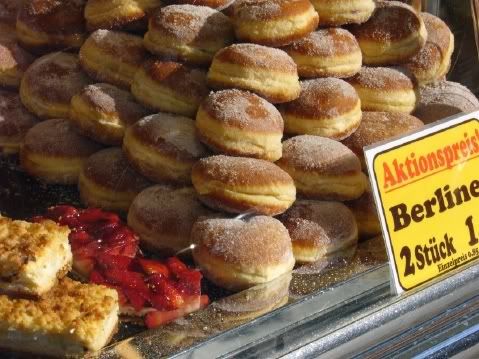
In Germany, you can get cold donuts from bakeries (glazed or cinnamon donuts), but top consumption goes to the Berliner
(known as jelly donut in the States, though I'm having a serious memory block over what we call them in NZ. I think they are known as another animal to the ring-shaped and dusted variety, right?)
In Germany when it comes to bakeries the Berliner rules the roost. Witness the huge glass walled stacks of them at Merzenich chain bakeries for ambling shoppers and children of shoppers. Rather gothically, their jelly filling is injected with a large syringe post cooking.

Photo Sharing and Video Hosting at Photobucket

But when cruising Christmas markets and malls or supermarkets, for your hot fried and/or doughy treat, you will have much more luck finding either waffles or (mostly at Christmas time) the delicious 'reibekuchen'.

A typical scene at the entrance of Kaiser's supermarkets:

Photo Sharing and Video Hosting at Photobucket

The waffles are of course very good, especially when accompanied with a thick cherry compote like the ones at local theme park Fantasialand. (The waffles are pretty much the highlight of Fantasialand by the way, though supposedly Michael Jackson is a big fan of their roller coasters. But the Chinese acrobats in the Chinatown section performing to high speed euro pop in faded neon leotards? How hokey)

Getting back to the important stuff (i.e. fried treats), Reibekuchen - grated potato pancakes served scalding hot with apple mousse - are damn good.

Basically,
this:
MySpace Codes


leads to this:

MySpace Codes


and it all ends in this:

MySpace Codes


Super on a freezing night with a cup of Glühwein.

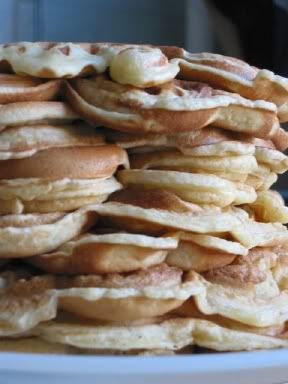
Here is a recipe for banana-lemon waffles from a woman living in Berlin


Photo Sharing and Video Hosting at Photobucket

Blogger Templates by Blog Forum