Market Violence

Oh dear. This is very close to where Hock and I live....it seems even vege shopping is hazardous in Bangkok these days. Typical to the crap reporting of the Nation however, the below article doesn't tell you anything further about what exactly the vendors grievances against the Port Authority are, nor who likely suspects are? If anyone one knows more detail please tell


13 injured in explosion near Klong Toey market
An explosion occurred at a Bangkok intersection where vendors of the Klong Toey Market were rallying, injuring 13 of them, two severely.

Police quoted witness as saying a bag was dropped from the flyover over the Ratchada-Rama IV Intersection, causing the explosion at 1 am Friday. Bomb disposal officers have yet to determine the type of the bomb.

Some 1,000 vendors have been staging a protest at the intersection since Tuesday afternoon against the Port Authority of Thailand and Legal Co. The vendors protested against what they claimed to be unfair treatment against vendors at the Klong Toey market.

The injured protesters were rushed to the Kluay Nam Thai and Chulalongkorn hospitals.

Two of them were severely injured. They are Yakob Lohmoh, 51, and Penthiwawan Kaewsuk, 37.

Sujittra Damrongsiri, 52, a protester, said she saw a man on a motorcycle dropped a plastic bag onto the tent where the protesters were resting and an explosion occurred shortly.

Pol Lt Col Prapassorn Chartprom, deputy commander of the Tha Rua police station, quoted witnesses as saying that the bag did not explode immediately but it exploded about five seconds after it landed on the tent's r

Phil Lees - Food Warrior

According to the Melbourne Age


FOUR days spent steering a motorbike north from Chiang Mai along the Burmese border along dangerously snaking roads must have made food blogger Phil Lees challenge his actions. Surely, he questioned the madness of making a white-knuckle, eight-day return trip through bamboo-covered mountains to slurp one bowl of khao soi soup? In a word, no.

"I think, at some point, in the trip it just tipped over the edge," explains Lees, creator of Cambodia's first street food blog, http://phenomenon.com.

After three years in Asia, he recently returned to Melbourne and now writes a food blog, Mouthful, for SBS online. "Suddenly, we weren't going to see anything any more. We were just going to eat."

So when a Cambodian friend tipped him off that some of the tastiest khao soi came from a nondescript joint near the entrance to Mae Hong Son's market "a few lazy days on a motorcycle away", well, what choice did a culinary crusader have?

To this day, Lees says, that bowl of coconut creamy curry served over flat egg noodles and melting-off-the-bone-tender beef, with a tart complement of pickled cabbage, stands uncontested as the best bowl of noodle soup he's eaten. Welcome to the world of the food warrior. No dish too abstract, no taste too challenging and no geography too impassable, these obsessives hunt out the best of the regional, the seasonal and the unusual in their journey to uncover the heart of foreign cuisines. Leave the guide books to the masses, they say, donning their metaphoric khakis - there's a whole world of food experience out there and we're going to hunt down every delicious bite.


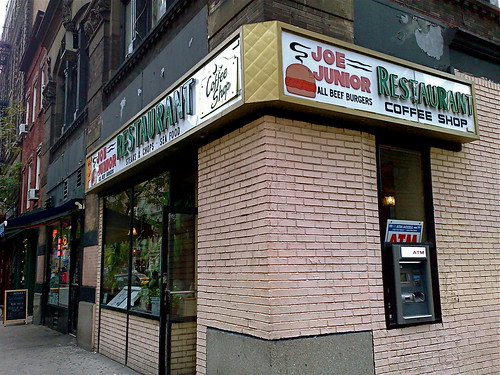
I wonder if this is the same as Hock dragging me half way across town to eat a crappy diner breakfast at Joe Juniors in NYC just cause he's read about it being good by some hack on the intertubes....does half an hour on the subway and digesting half a pound of pure fried American fat at 9 am in the morning count as hardcore? Can we join the food warrior club too?

051020081095

051020081094
On two occasions now I have been corrected on my pronunciation of Asakusa, both times by white guys who giggle at me and then say something along the lines of "don't you mean Aaahhh-saak-saa". So I asked my friend Kumiko who comes from Japan...."how do you say Asakusa?" and she looked at me blankly and said "Asakusa, just how you said it". I said "are you sure" and she said "of course I'm sure I'm Japanese"

Which made me giggle, cause I've always just pronounced Japanese words in the same way that I learnt how to pronounce Maori words at primary school and it seems the two languages have a lot in common in terms of their use of vowels.

Anyway, we had a lovely time when we stayed in ASAKUSA.

P1140892

As warned by Nalika, yes it's a bit old and a bit touristy and that suited us down to the ground

I couldn't be bothered being yelled at by grumpy old ryokan owners this time like we were last when we stayed further out in cheaper areas. And being very jetlagged neither could we be assed catching trains for hours to go anywhere. Instead we just hired little bikes and rode around the neighbourhood and Ueno park with all the other little old Japanese people who seem to inhabit ASAKUSA.

ASAKUSA was also right next door to a very festive looking temple with a lot of touristy street vendors, convenient for gift purchasing and sampling

P1140916

We found this man who makes fresh and slightly overpriced shichimi out of the seven original spices: dried chilli, orange peel; sesame seed; poppy seed; hemp seed; nori and ground sansho

P1140900

I've only ever tasted the mass produced togarashi shichimi, never freshly made. Needless to say when all the flavours are fresh the spice mix tastes incredible.

There are other vendors in the area too selling local specialities like mochi balls and tempura, all who are equally willing to pose enthusiastically for tourists.

P1140910

P1140909

P1140912

Since discussing the idea of finding one's spiritual home with Ms Q the week earlier in NYC and pondering where mine is, I decided after another thoroughly enjoyable and successful stay in Japan, and since I'm not very spiritual, that on an extremely superficial level I love Japan!!!! For starters there are clean toilets everywhere, I never worry about having to crack a squat in a dirty or compromising place in Japan, the toilet seats often even open themselves and play pleasant flushing noises. There are cheap and yummy noodles and pork buns and tofu everywhere.

P1140931

P1140927

A seven eleven can quite easily provide me with over an hour's browsing and entertainment, not to mention a nutritious low fat and yummy meal. People are generally polite and gracious and I loose all fear of being mugged or loosing my wallet. Crime is low. I love a good scolding hot Japanese bath. The shopping is excellent and they have restaurants solely dedicated to crab, or eel or whatever your present seafood fixation happens to be. The public transport is easily navigatable and if it isn't some kind stranger will usually come to your rescue

I explained this to Kumiko and she shook her head, noting how difficult and oppressive Japan is if you live there, and I'm sure Japan is, should you happen to live there or in some way be embroiled in Japanese daily life. But for the tourist it really does provide the perfect hassle-free experience. I love Japan, or should I say Nihon? Naahhhhh.....Japan.

Berkeley on Lock: and Locavores reconsidered


After Maytel's amusing panning of Chez Panisse et al, I couldn't resist adding the above photo, which comes from the New York Times this week. It's an image from a Berkeley kindergarten. I love how sushi makes it onto the kindergarten radar.

Locavore is a word that has always made me shiver a bit: needlessly labeling a one-dimensional aspect of being a consumer.

Anyway, Robert Sietsema's first installment of his series on eating locally and cheaply (if not organically) in NYC, is quite interesting.
And his motivations are laudable. Down with ten dollar chops, I say! (They remind me too much of New Zealand).
Here's a new idea....Chez Panisse is passé

GASP!!!!!!!

I took the train to Berkeley, less than two hours from Davis towards San Francisco. I checked in at the French hotel and dined in the restaurant across the street. We are talking about Alice Waters’ place, Chez Panisse a restaurant well known to the readers of this blog and in-flight magazines.

There is the formal restaurant downstairs (fully booked) and the café upstairs (a late table was available). I had wine made of Zinfandel grapes.

I took the US$29 fixed menu. It had a garden lettuce salad, spaghetti alla Norma with eggplant, tomato, basil, and ricotta salata, and a Concord grape sherbet with roasted Thompson seedless grapes and langues de chat.

These were the variety names on today’s menu: Concord grape, Thompson seedless grapes, and Little Gems lettuce.

And these were the farm names on the menu: Cannard Farm3, Andante Dairy, Soul Food Farm, Marin Sun Farm, Lagier Ranches, and Frog Hollow Farm.

Terroir trumps agrobiodiversity at Alice’s place.

It is a good restaurant. It is very French. The waiter spoke of terroir as if his name were Claude Duchateu. It is very cheap for a famous restaurant. It has a local twist to it. The food is good. But is mainstream now. The menu in the Davis Best Western Palm Court was not that different.

I suppose it is fair what everybody says, that Alice created some sort of revolution. From the wasteland of the American diner to Good Food. Just like her neighbor Alfred Peet transformed mainstream American coffee from diluted sewage to the best coffee anywhere save (perhaps) Italy. But that is ancient history.

But, just for your information, Chez Panisse is passé now. Go look somewhere else. I have heard of an underground restaurant movement in New York.

Chez Panisse is sold out every night, I think. Alice can experiment. But she does not. She chooses the middle of the road. Their produce comes from “farms, ranches, and fisheries guided by principles of sustainability” but the majority of entrees (main dishes) are a fish or meat dish.

Chuck out the meat. Serve different varieties of other veggies than tomatoes (even the Andronico’s supermarket across the street sells heirlooms). Use something locally evolved rather than merely locally grown. The native Californians used hundreds of edible plants.4 But no miner’s lettuce or acorns on the menu of the Queen of Slow Food. Come on, Alice, surprise me!


Source: Robert Hijmans Agricultural Biodiversity Website

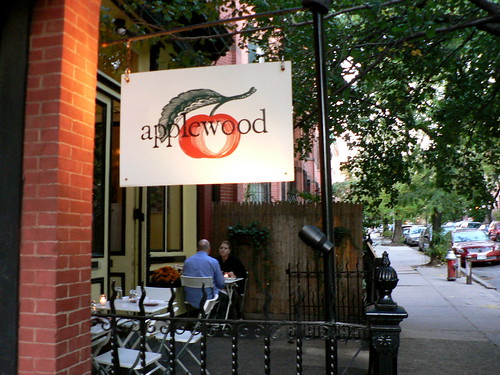
Hmmm, so where can slow food and "locavores" go from here? A good point indeed since the restaurant business is so competitive one does need to constantly be redefining ones niche in order to add novelty and therefore value. It is essential to maintain the buzz.....and with more and more restaurants serving Alice Watery style menus.....such as Applewood in Brooklyn I'd have to agree with Robert.


P1140786

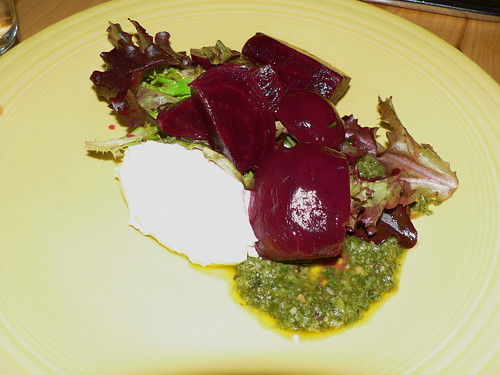
The meal we had here was not astounding. While everything was well cooked and tasted nice it was simple and I must say that aside from the price tag there was precious little appreciation to be had in eating organic local beets and salad. The food was good, or better yet "nice".

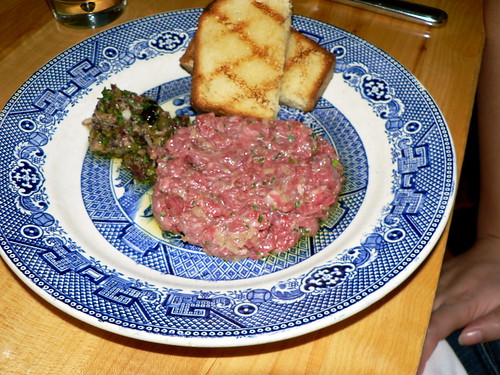
Applewood, like Chez Panisse is a farmer to restaurant type deal. There is organic/ fairtrade hand wash in the bathrooms and the tables were adorned with vases of fresh cut thyme which I snapped off "a la Thai style" and added to my under-seasoned beef tartar (I asked for extra chili but they wouldn't give it to me)

The bill around USD$80 including wine.

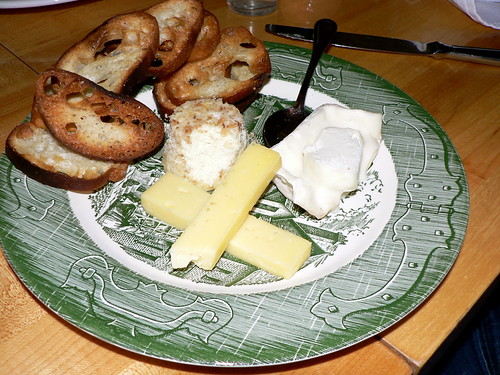
I had beets, the tartar and "artisinal cheese selection" to finish

Beets
P1140795

Beef
P1140798

Cheese
P1140807

I was too busy talking to notice what other people ate....but here are some other photos

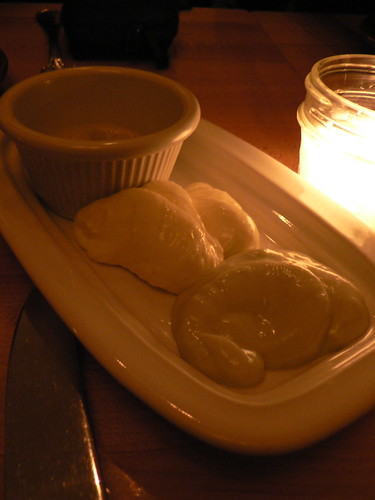
Delicious selection of handmade butters and dips to start
P1140793

Maine Lobster thingy
P1140796

???
P1140797

???
P1140794

???
P1140799

Chocolate Ding Dong, as Hock likes to call them....always a crowd pleaser
P1140806

So now that most inner city hipster regions of the United States now have their very own version of Chez Panisse what happens?

How much more "in touch" can this restaurant niche get? Should restaurants of this theme, as Robert suggests, go deeper still attaching perhaps scientific names to the menu and explaining the role your food played in an ecosystem? Should they only allow diners to eat a limited portion of meat? Perhaps they should only be cooking off the menu of under-utilised species in line with the principle that eating endangered species is the best way to preserve them.


With some quarters of food criticism already underway against molecular gastronomy , should Alice Watery restaurants be moving towards more sophisticated cooking techniques or furthering the general populaces' appreciation for quinoa?

Or hows about molecular Khmer food....anyone?

Paroxysm in food

Working for three years in Cambodia can leave you feeling a little detached from the outside world.

When it comes to your own growth as a professional chef I can’t stress enough how important the inspiration that you receive from your fellow peers is.

Simple things that you might take for granted when living in a more developed country did not exist for me in Cambodia when I worked there. Taking the time to visit suppliers (local markets were awesome in their own right but I am talking more about the more modern food movement) or reading food magazines were pretty much out for me. Parcels from my folks via the Khmer mailing system would take months to arrive, so a glossy magazine with pretty pictures of food were out too. You could pretty much forget about attending food expos and dining at others restaurants. Let alone the simple pleasure of meeting up with like minded cooks at a local bar after a difficult days service and drinking the night away while discussing the differences in an egg cooked at 63°C versus one cooked at 64.5°C. All very exciting and important stuff but an after work conversation was more likely to be on the lines of “Hey Pascal where the fuck can I get some butter? You got any butter? Don’t lie to me now, Sophea said you had some”

Luckily I was surrounded by a few (read two other chefs) and I was lucky enough to work with one of them . The French national "Jo". (check out his second cook book here his first is only available in French)

J-Lo from the Block.jpg


Sure we created some cool stuff, that we are both still proud of.


That both didn't stop us at the time from wanting to know how did that crazy little fucking Spanish chef do that?

While valium, xanax, heroin and mangosteens were readily available to us, Iota, xanthan or methocellulose was not.

My only real contact with the international cooking scene was through a very slow slow and unreliable internet connection (Think $300 USD a month for a service barely faster than dial up).

That’s when I came across Ideas in Food.

Thankfully because of Aki’s and Alex’s generous sharing of ideas via their blog from early ‘05 until now it has allowed me to feel as though I might be able have a small understanding of the latest techniques floating around the culinary world.

So whilst in NYC, why not take the F train from Manhattan and spend a day catching up on some new techniques?

So it came to pass that when Maytel and I decided to go to New York for a holiday I would take a day off from eating oysters, hamburgers and the likes and spend the day in Queens.

So like a true fanboy, I found myself mid morning inside the cutest little house on the sweetest little street about million miles away from the complete normaility of life in Bangkok, the city that I currently call home. I spent an amazing, eye-opening six hours with two extremely lovely and passionate people.

P1140492

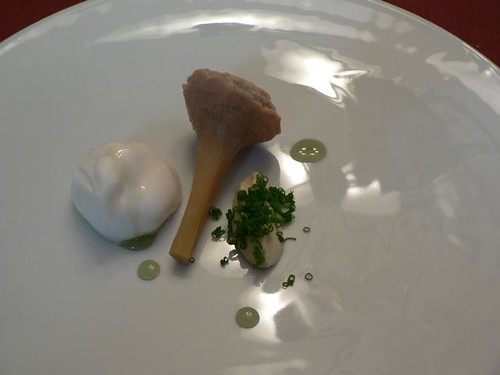
When I arrived we chatted over donuts and coffee about this and that, then Alex plated up an incredibly pure tasting artichoke dish that he had been working on, this set the tune for what really was an amazing day.

P1140524

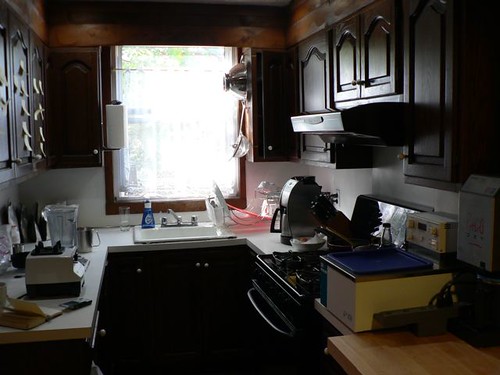
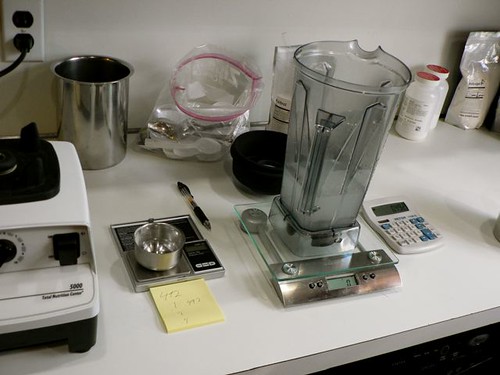
From this tiny, but crazily-equipped, kitchen we ran through the topics that I really wanted to become more familair with.

P1140497

P1140494

P1140496

P1140504

Some whipped products. No, those are not egg whites.

P1140505

P1140514

To some fruit glueing.

P1140501

P1140518

P1140519

P1140520

P1140526

Like all good chefs they offered the perfect lunch.

P1140506

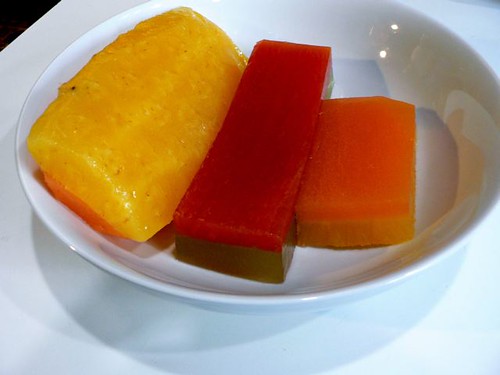
Then we ended the day with some other variations on pectin.

P1140521

What I loved about watching Alex work was other than the fact that he was mad excitable, he also couldn't help but let his true chefiness slip out. Although we both tried to be on our best behaviour as this was the first time we had met face to face Alex was swearing like a trooper towards the end of our session. I have worked in four different countries and all chefs seem to behave the same way if not for swearing then maybe a good dick joke, why is that?

Alex and Aki were right. After the days class was through my way of thinking about food would be different. They could not have been more right.

The days experimenting wasn't perfect mind you.

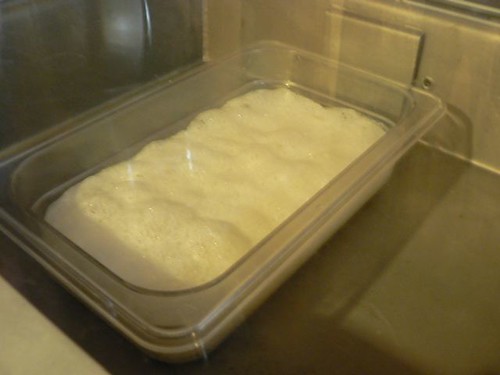
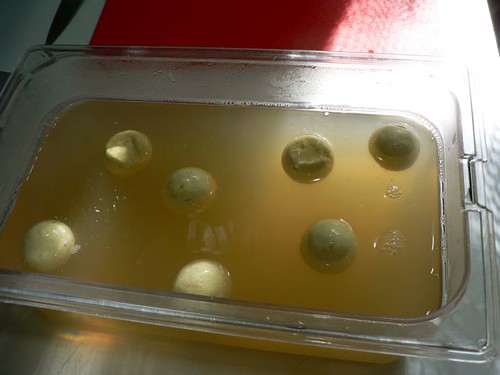
After not allowing the above pectin bath to cool properly the little sauce orbs didn't come out the way they should have. "Don't do that, wait for the bath to cool" was Alex's advice.

"Do you make many mistakes or have many failures?" I asked.

"I fuck up all the time" he replied.

I personally hope to be fucking up over the next two months and have high hopes for next year too.

Here is the shopping list that I am currently working on.

Activa YG
Liquid Nitrogen local supply?
Liquid Nitrogen Dewar small shallow dish
Liquid Nitrogen Dewar holding 25 - 30 ltrs
Pacojet coup Blade set
New and larger chamber vacuum machine
Plastic acetate strips
Pectin LM
Pectin LMA
Fruit powders
Methocel A15C
Methocel F50 
Maltrin M100 Maltodextrin
Calcium Lactate
Locust Bean Gum
Calcium Glunconate
Calcium Lactate
Carrageenan (Iota)
Carrageenan (Kappa)
Konjac
Kelcogel Gellan Lt-100 (elastic)
Kelcogel Gellan F (Firm)

Cooler Fun.

LN2 Avocado
Super freezing avocados

It is an amazingly simple task when it comes to blending super frozen items into a fine snow (vivid green coloured snow in this case) especially when you take food close to -196°C in a matter of minutes. The powder/snow that we created made a great finish for a tomato hops broth with a garnish of pure halloumi noodle which we also blended and bound with a percentage of Methocel A15C to form a wonderful salty cheesy take on pasta.

P1150140

Another cool use for LN2 is its ability to turn liquids into little pearls of yumminess, coconut pearls in this case. We used our mighty Pacojet to spin 100% pure frozen Thai mangos into a creamy sorbet then finished this little pre-dessert with coconut pearls made from fresh Thai coconut cream and then finished the shot glass with freeze dried "organic" banana granules which of course came from Switzerland.

P1150129

P1150175

Mango, coconut, banana

P1150145
Soft shell crab salad (from the same menu)

P1150178
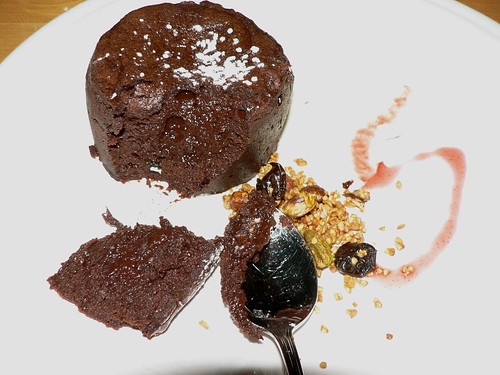
Chocolate chestnut dessert, cocoa nib ice cream (also from the same menu)

P1150121
Chef Rongs very cute two year old son seemed to enjoy the cocoa nib ice cream.
The day we left New York was a Sunday, and after a week of eating up and down the American East Coast food chain and checking out the full spread of NYC cuisine, it felt almost like a parting gift from the NY Times gods on high that their Sunday edition magazine section was entirely about food and aptly named "Food Fights". The magazine included some interesting articles on tipping, one about kosher meat and a very long open letter by Michael Pollan (post-productivisms poster boy) to the next president of the United States, Farmer in Chief, as he so optimistically called him.

In the article Pollan argued, pleaded and cajoled for the next president (now we know him as Obama) to rethink the American food system on a grand scale. Pollan called for Obama to:
- move away from oil dependent productivist farming practices that produce mountains of food and drive down the price of food at the peril of the climate, energy independence, American health, farming ecologies and rural communities everywhere around the world
- to move towards "post-productivist" practices and systems based on "alternative" food systems: organic, local, pasture based, humane and above all based on solar power not carbon energy.

The 8 web page long article, Pollan acknowledged that while the industrial food system is indeed a marvel it is inherently unsustainable, and called out the ill-logic of seperating protien production from grain, advocating a move back towards poly cultures rather than subsidised mono-cultures that don't even go into "food" production but low quality calories, animal feed and biofuels. He railed against globalised food economies and warned they are coming to an end. He advocated supporting municipal composting and "perrenialising" agriculture, through solar based grass fed livestock production aimed at reducing meat production and consumption. Although by Pollan's own admission whether or not such a food system would be capable of sustaining the American population is up for debate. Yet Pollan is self-assured it's worth a try, believing that organics can produce same amounts of food, but requires people to move back to the farm. Yes, he supports re-ruralisation and the re-education that would be required to achieve this new American food system (a statement that conjured horrifying images of the Khmer Rouge or China's disastrous past). He advocates decentralised local regional food systems, grants to support farmers markets, reduced food processing regulations and the introduction of local meat inspectors. Pollan believes there should be a strategic grain reserve and a regionalised food procurement system which if the Republicans haven't had enough of smearing Obama as a socialist by now, they surely will be reinvigorated to do so if Pollan's manifesto was ever to be implemented. Pollan also requests the creation of a Fedaral definition of food, which makes "real food" exempt from sales tax. In Pollan's utopia, food stamp cards would double in value when used at farmers markets. We would educate children a la Alice Waters with edible gardens and oil used in the production of food would be on labels. Finally barcodes would include stories of the full production process when scanned.

Well golly!

Now I don't disagree with Pollan that there are some serious problems with the American food system (and this does not in my view mean by extension the whole world's food system, although many people seem to think it does). The noticeable lack of fresh fruit and vegetables and indeed the cost of anything green was most surprising to Hock and I on our visit. A bowl of fruit salad was roughly double the price of a bacon and egg sandwich, which left me with no doubt that their's is a fucked up food system indeed. But does it require radical change?

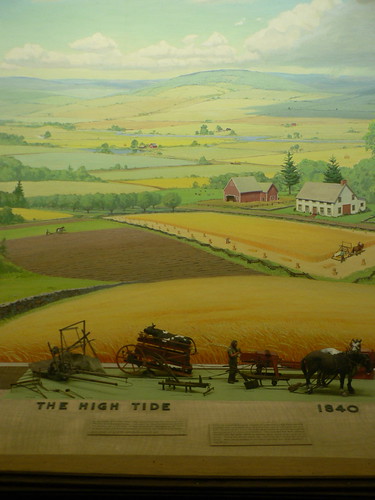
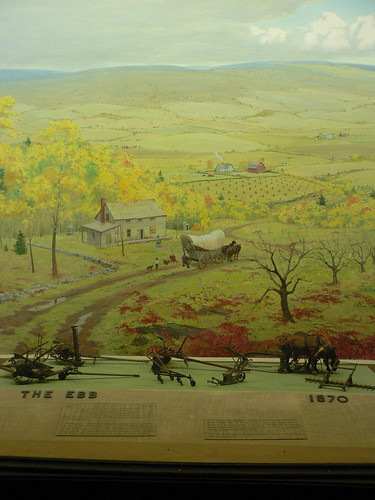
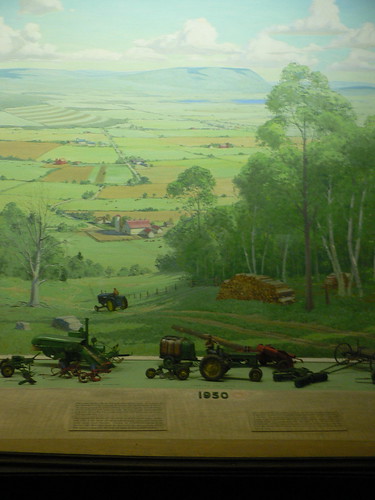
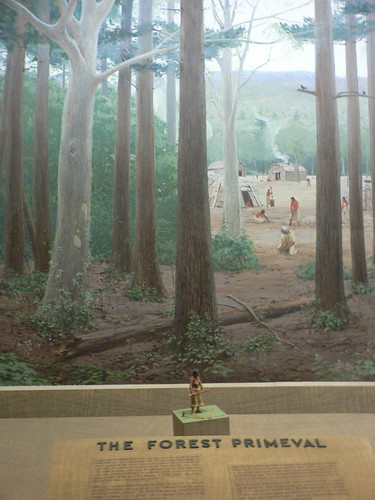
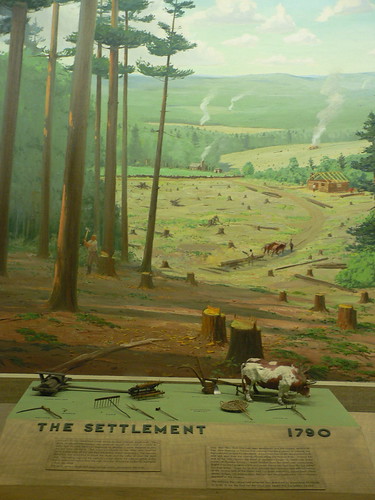
A small insight into the minds of American food radicals came to me on a visit to the Museum of Natural History. (I love Natural History museums. I love looking at rocks and species of bugs stuck to pin boards and the like). The Museum had some pretty spectacular exhibitions, especially the planitarium and whole space area in general. Some big money had obviously gone into funding the space section, as opposed to say the "agriculture" area which presented a uniquely linear, mid-century/ modernist/ productivist world view of agriculture. I'm sure most visitors to the museum don't even notice the exhibit situated in a corridor on the way to the far more sophisticated presentations on evolution and ever-intriguing rocks. Instead the exhibit is so outdated that it could be considered an artifact unto itself, with its dusty old cabinets and Fifties fonts invoking a kind of sentimentality for the good old days of Elly May and Uncle Buck, apple pie and soda pop. Harking back to those pre-diabeties, pre-obesity epidemics days, long before the term "food dessert" could be understood in urban terms and when corn was simply the best thing before sliced bread. Perhaps that is why they keep the dusty lined cabinets which detail agricultural development as a linear process that moves from "primeval forest dweller" (note dark skin colour) to settlement and high production (note white farmers, no slaves present in farm scenes). Maybe they keep it for posterity's sake, or maybe its just because Michael Pollan lives in Berkley.
P1140672

P1140673

P1140674

P1140675

P1140676

I was also much amused by the diagram on soil fertilisation, which depicted in no uncertain terms the benefits of agrochemicals. The smaller grassy mound's title reads "unfertilised" with the large towering grassy mound reading "fertilised". It is quite clear from this and the other exhibits that more is certainly more, bigger better.

P1140677

Which is pretty much where that the diagrams end. The museum's outdated "agriculture" exhibit serves as a pertinent reminder to the fact that very little thought has gone into "developing" agriculture in America by the federal state since the 1950s. Here "agriculture" remains locked in "space" and "time" and with not a hint towards the food fights and furores that continue to rage outside in post-modern America and indeed the globe. Should the exhibit be merely extended on beyond its current displays, what would we see? Perhaps there would be landscape paintings of the horrors Pollan describes....corporate farming in America....perhaps an exhibit devoted to explaining the problems associated with mono-cultures? Maybe an exhibit with smell-o-vision where one can sense they are approaching a pig or cattle feed-lot? Further still, some particularly radical curator might have taken delight in scaring the hundreds of children that tour the museum each day with an exhibition on the modern abbattoir? Maybe they could just have one horrible black stinking miniature scale pit to represent the black hole that Pollan believes American agriculture has become. Perhaps they would have an exhibit filled with cheap Mexican labour picking fruit, or even a diorama of small-scale african farmers starving due to global agricultural commodity dumping by countries like America that compromises their economic viability and puts food sovereignty of developing nations at risk.

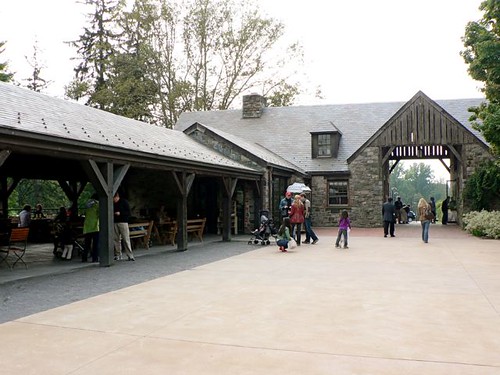
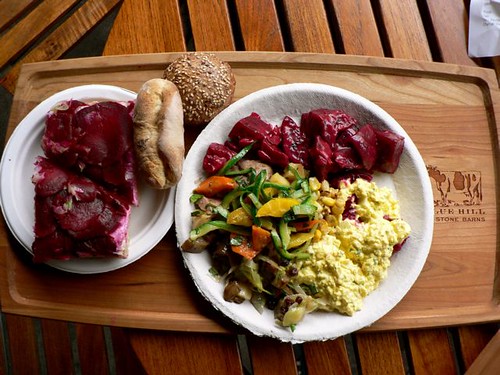
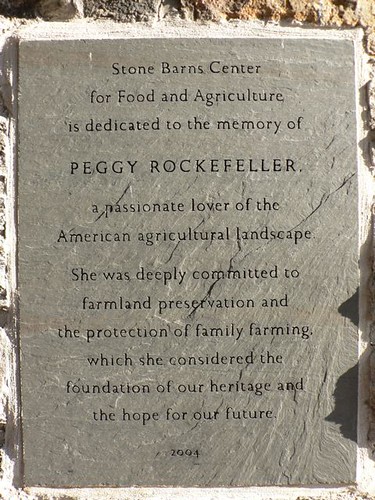
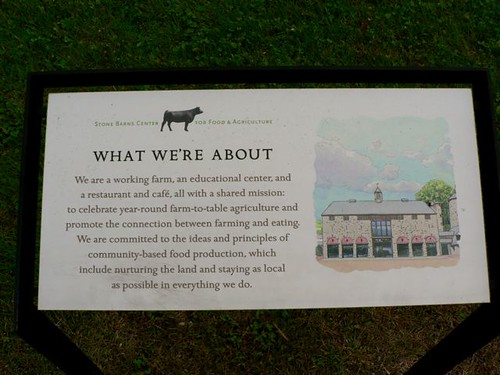
But if the exhibit extended further still and took the "agriculture" exhibit to its present day Micahel Pollan ideals, perhaps we might end up with a miniature version of Stone Barns a new type of "post-productivist" farm located half an hour by train outside of New York in a place called Tarrytown. A model farm or vision of what some people want agriculture in the United States to be like today. Something that looks very "Alice Watery" indeed.

For this we would need diorama of a medium scale diversified farm, including upscale restaurant with resident "celebrity chef". As such a medium scale farm these days can barely be economically sustainable, true to real life the exhibit like the farm should be funded by the Rockerfeller Foundation. Multiplicity here is the key, as mentioned by other rural sociologists of the developed world. Thus this farm would also have a cafe, walking tracks, events room and more. It would be more than a farm, but instead an educational centre and tourist attraction. There would be mini porches and BMW's in the car park and white people riding horses. There would be tiny signs everywhere that educated people as to what garlic chives look like and spelt out proper farm place behaviour. There would be tiny home-made jams and pickles for $10 USD a jar and overpriced egg and beet salads.
P1140457

P1140440

P1140425

P1140442

P1140418

051020081105

If the Museum of Natural History were to continue its agriculture exhibit in a linear fashion true to Michael Pollans views, it would go from Primeavel Forest Dweller to the 1950s, through to the horrors of industrial agriculture and on to Stone Barns and beyond to the full utopia. Food systems would be presented as an either/or dilemma, a binary choice between evil corporations or medium scale organic farms filled with re-educated workers. Or perhaps the Museum should just trash the whole section in favour of something far more interactive, diverse and inclusive? Perhaps the Museum should, more sensibly, rethink the whole idea that agriculture and food systems are in some way linear and instead represent them as mixed diverse systems that at times need of intervention to ensure peaceful coexistence. Where, industrial and local food are all deployed to ensure resilient food systems that provide both quantity and quality to all people at all budgets whether primeval forest dweller or New York foodie hipster.

For sure a week of wandering around New York and craving more green things gave me an understanding of why many Americans are increasingly radical about their food politics, but utopians and binaries always create the need for radical opposition.

Blogger Templates by Blog Forum